
Key takeaways
- 01The goal is steady ad income from a niche, not a personal brand.
- 02Videos are narrated and faceless, and they follow a repeatable format.
- 03YouTube does not pay for mass-produced or repetitive content, so each video must add real value.
How cash cow channels work
The owner picks a niche where viewers watch many videos and advertisers pay well. Common examples are history and true-story documentaries, finance, science and top-ten lists.
Each video follows the same format: a researched script, a voiceover, visuals and captions. Owners often hire writers and editors, or use AI tools, so the channel can keep publishing without them. This is called YouTube automation.
The rules that matter
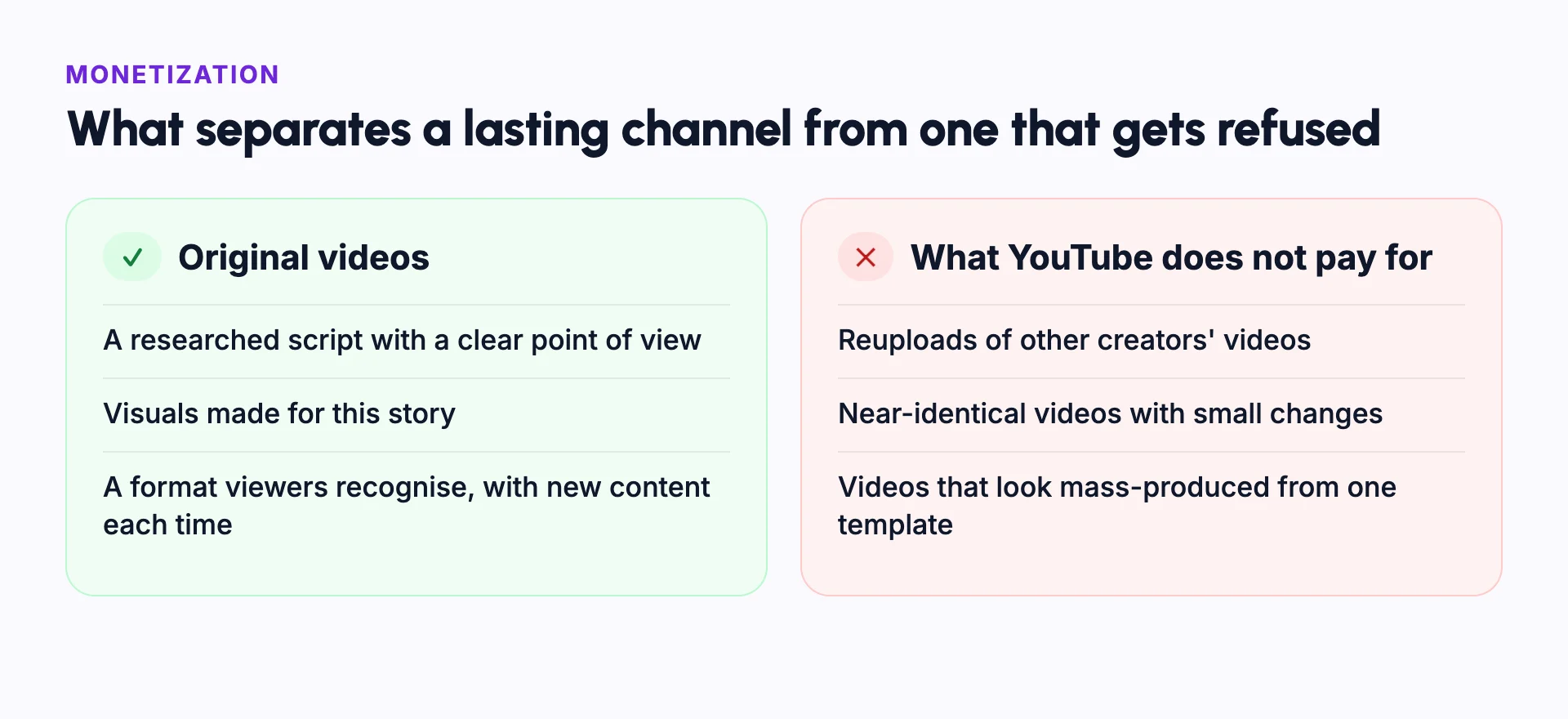
The name suggests easy money, but YouTube's monetization policies say channels cannot earn from mass-produced or repetitive content.[1] Channels that reupload, copy, or make near-identical videos can be refused or removed from the YouTube Partner Program.
The channels that last make original videos. They have a clear point of view, real research, and visuals that fit the story. Read YouTube's current policies before you start, because they change.
Example: what makes one channel last
Two channels post daily videos about space. The first reads the same type of fact list over stock clips, with only the numbers changed. The second picks one question per video, like why Mars is red, researches it and writes its own answer.
Both use a repeatable format. Only the second adds something new each time. YouTube's monetization policies do not pay for content that is mass-produced or repetitive, so the first channel is at risk.[1]
Costs to plan for
A cash cow channel looks cheap, but every video has real costs. Plan for them before you commit to a daily schedule.
- Writing and research time, or a writer's fee.
- Voice, visuals and music, from AI tools or stock libraries.
- Editing and review time for every video.
- Thumbnails and titles, which you test and change over time.
How to keep it sustainable
Batch the work. Write a week of scripts in one sitting, then make the videos.
Use one template for the look and feel, and change the content every time. Track which topics hold viewers, and make more of those.
Cash cow channel vs faceless channel
| Cash cow channel | Faceless channel | |
|---|---|---|
| Main goal | Income from views | Any goal: income, a brand, a hobby or a business |
| Run like | A small media business | A creator project of any size |
| Team | Often writers, editors and voice artists | Often one creator |
| Relationship | Most cash cow channels are faceless | Not every faceless channel is a cash cow |
Common mistakes
Reusing other creators' videos
Make every video from your own script and visuals.
Changing only the numbers in a template
Use a template for the look, and write new content each time.
Chasing views over quality
Focus on watch time. Viewers who stay are worth more than clicks.
Not checking facts
Check names, dates and numbers. Wrong facts lose trust and get comments.
Treating it as passive income
Plan time each week for writing, review and testing titles.
In Frameloop
How it works in Frameloop
- Frameloop makes faceless videos from an idea or a script, with original AI visuals or stock footage.
- A recurring cast of saved characters gives each channel its own identity.
- Automations can make new videos on a schedule and auto-publish them to YouTube with an AI-written title and description.
- Review every video before it goes out under your channel's name. AI output varies.
Questions people ask
Are cash cow channels allowed on YouTube?
Yes. The format is allowed. Videos must still be original and follow YouTube's monetization policies, which exclude reused and repetitive content.[1]
How much can a cash cow channel earn?
It varies widely by niche, views and RPM. Many channels earn little at first. Treat any income figures you see online with care.
Can AI make cash cow videos?
AI can write drafts, voice scripts and make visuals. Each video still needs a real topic, a review and a clear point of view.
How often should a cash cow channel post?
As often as you can keep quality high. A few strong videos a week beats daily videos that look the same.
Sources
- [1]YouTube channel monetization policies, YouTube Help