
Key takeaways
- 01The owner runs the channel like a business and hands off the production work.
- 02Work can go to freelancers, to AI tools, or to both.
- 03Automation helps with volume. It does not replace a good topic and an original video.
Two ways to automate a channel
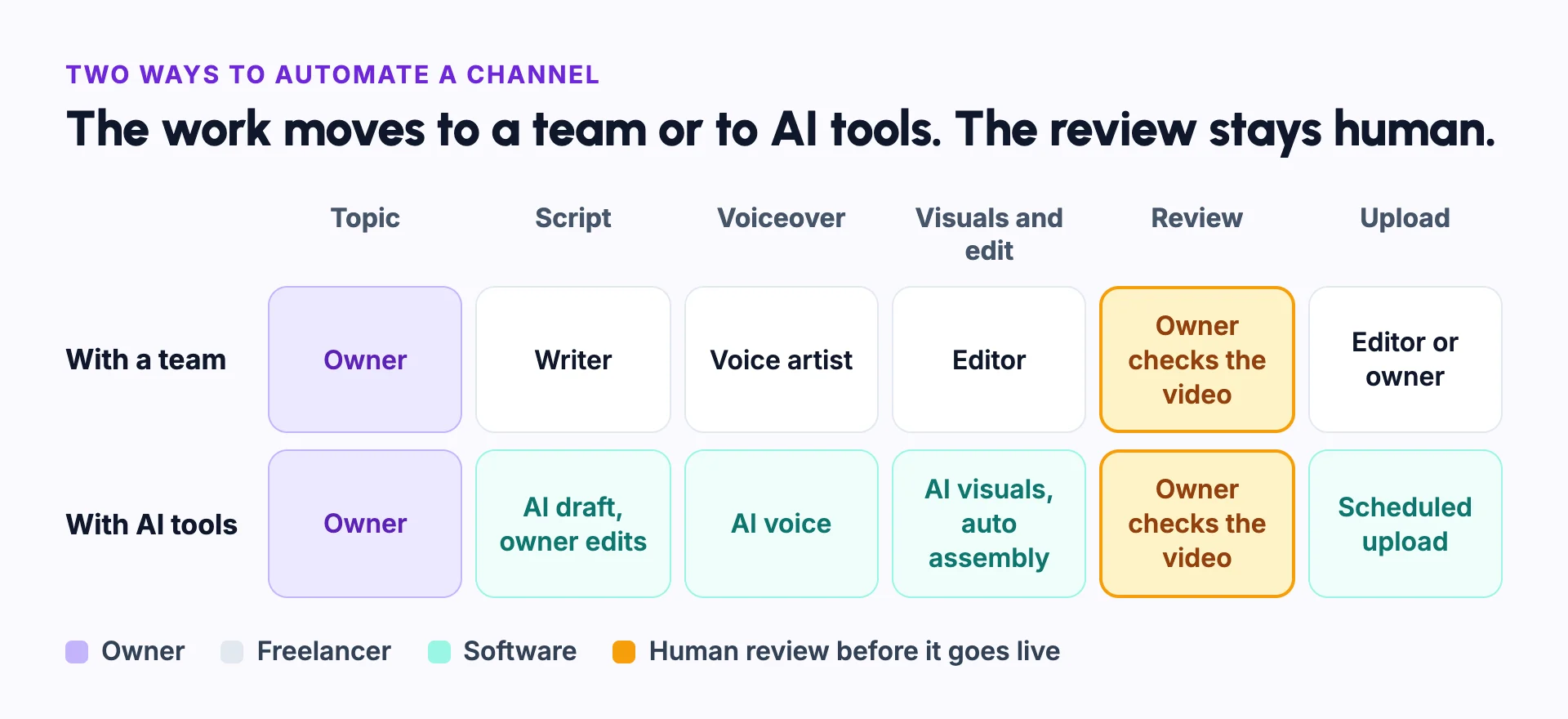
The older way is a team. The owner hires a scriptwriter, a voice artist, an editor and a thumbnail designer, and manages them.
The newer way uses AI tools for some or all of those steps. One person can then run a faceless channel, or several, that would have needed a team.
What YouTube's rules mean for automated channels
YouTube does not ban teams, tools or AI. Its monetization policies look at the videos: they should not be mass-produced, generic, repetitive or manipulative. That includes AI-generated videos made from generic templates.[1]
In July 2025, YouTube renamed its "repetitious content" policy to "inauthentic content" to make this clearer.[1]
Realistic AI content has its own rule. Creators must disclose AI-generated or altered content that seems realistic.[2] This is called AI content disclosure.
Where human input matters most
Automation can draft and assemble. These steps still need a person:
- Choosing topics the audience wants.
- Giving each script a point of view, not a summary of other videos.
- Checking facts, names and dates.
- Watching each video before it goes live.
- Reading comments and adjusting the next videos.
Example: a history channel that posts three times a week
Say you run a history channel that posts three Shorts a week. Once a month, you pick 12 topics and write one line on the angle for each.
AI tools draft the scripts. You edit each one, add the detail that makes it yours and check the facts. The tools then add the voice, the visuals and the captions.
You watch every video before it is scheduled. Your time moves from making videos to directing and reviewing them, but you still decide what goes out.
What automation does not solve
Automation makes it easy to publish more. It does not make people watch. This is true for cash cow channels too.
A channel still needs good topics, original videos and a human review before each upload.
Team-based vs AI-based automation
| With a team | With AI tools | |
|---|---|---|
| Who does the work | Freelancers you hire and manage | Software, with you editing and reviewing |
| Cost | You pay each person for each video | A subscription, or credits for each video |
| Speed | Days per video, depending on the team | Minutes to generate, plus your review time |
| Main risk | Managing people and keeping quality steady | Videos that feel generic or repetitive |
Common mistakes
Reuploading or lightly editing other people's videos
YouTube treats this as reused content, and it does not qualify for monetization.[1] Make original videos.
Publishing without watching
AI output varies. Watch every video before it goes live.
Using one template for every video
Vary the hook, the structure and the visuals. Videos that look made from a template are what the policy targets.[1]
Chasing volume over watch time
More uploads do not help if people stop watching. Post fewer, better videos and track audience retention.
Leaving realistic AI content unlabelled
Disclose it when you upload a video that looks real.[2]
In Frameloop
How it works in Frameloop
- Automations make new videos on a schedule from a topic you write or a preset topic.
- There are two series types: script-to-video series and music video series.
- Each video can be emailed to you as an MP4, or auto-published to your YouTube channel with an AI-written title and description.
- Automations need a paid plan. The number of active series depends on the plan.
Questions people ask
Is YouTube automation allowed?
Yes. YouTube allows teams and AI tools. It does not pay for videos that are mass-produced, repetitive or reused from other sources.[1]
Can an automated channel make money?
It can, if the channel meets the YouTube Partner Program rules and its videos are original. The policies change, so read them before you start.
Do I need to show my face?
No. Most automated channels are faceless channels. The topic and the format carry the channel.
Can AI upload the videos for me?
Yes. Some tools publish to YouTube on a schedule, with a title and description. Keep a review step before each video goes live.
Sources
- [1]YouTube channel monetization policies, YouTube Help
- [2]Disclosing use of GenAI content, YouTube Help