
Key takeaways
- 01One video, one idea. Explainers work best when they stay focused.
- 02A simple structure works: the problem, the explanation, the takeaway.
- 03Explainers work as Shorts and as long-form videos.
A simple explainer structure
Most good explainers follow the same path.
- Hook: a question or a surprising fact that makes people curious.
- Problem: why this matters to the viewer.
- Explanation: the idea, step by step, with a visual for each step.
- Takeaway: one thing the viewer should remember.
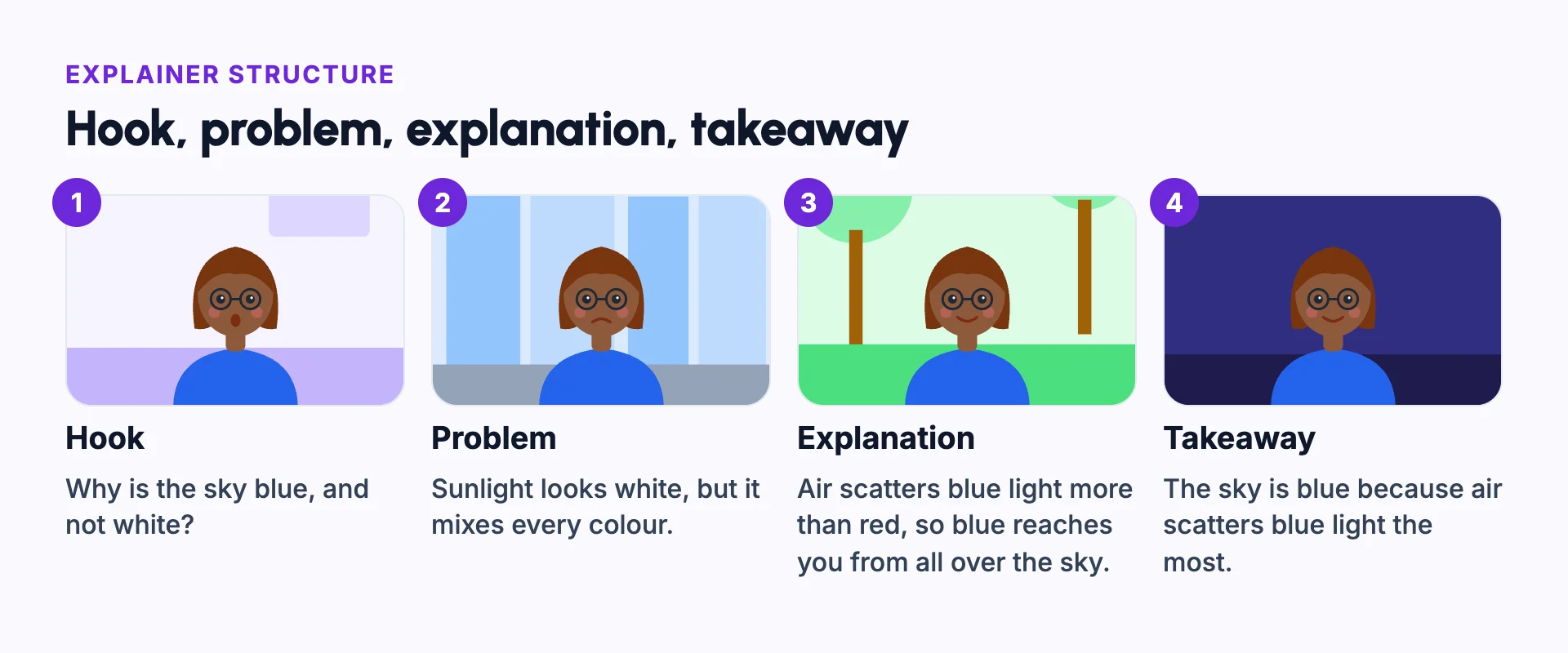
Example: why the sky is blue
Hook: "Why is the sky blue, and not white?" The question is simple, and most people cannot answer it.
Problem: sunlight looks white, but it is a mix of every colour.
Explanation: when sunlight hits the air, tiny gas molecules scatter short blue waves much more than long red ones. Blue light bounces around the whole sky and reaches your eyes from every direction. This is called Rayleigh scattering.
Takeaway: "The sky is blue because air scatters blue light the most." One sentence the viewer can repeat to a friend.
Each step gets its own visual: a question over a sky, white light splitting into colours, blue light bouncing between molecules.
Where explainers are used
Creators use them on faceless channels about science, history, psychology and money. Businesses use them to show how a product works. Teachers use them to explain one topic at a time. Longer, story-led explainers become documentary-style videos.
Visuals should show what the narrator is saying, not just decorate it. A recurring character, like a guide or a mascot, makes a series of explainers feel connected.
How long an explainer should be
As short as the idea allows. One clear idea often fits in 60 to 90 seconds.
Product explainers on a website are usually one to two minutes. Educational explainers on YouTube can run five to ten minutes when they cover several ideas.
If the video feels long, cut examples before you cut the explanation.
Watch where viewers leave. If many drop off before the explanation starts, the hook or the problem section is too slow.
A short explainer also works as a trailer. Post a 60-second version as a Short, and link it to a longer video that goes deeper.
Explainer video vs tutorial
| Explainer video | Tutorial | |
|---|---|---|
| Answers | Why or what | How |
| Goal | Understanding an idea | Completing a task |
| Structure | Hook, problem, explanation, takeaway | Steps in order |
| Example | Why the sky is blue | How to change a bike tyre, as a tutorial video |
Common mistakes
Starting with background
Open with the question or the problem. Background can come later.
Explaining several ideas at once
Cover one idea per video, or split it into clear parts.
Using jargon without a definition
Define each new term the first time you use it, or leave it out.
Visuals that only decorate
Show the idea itself: a diagram, a before and after, or an example.
Ending without a takeaway
Close with one sentence the viewer will remember.
In Frameloop
How it works in Frameloop
- Make an explainer from a topic or a script, as a Short or a long-form video.
- Frameloop splits the script into scenes and adds visuals, voiceover, captions and music.
- Add a saved character as a recurring guide across your explainers.
- Videos can run from 15 seconds up to 30 minutes, depending on your plan.
Questions people ask
What makes a good explainer video?
A clear question, a simple explanation with a visual for each step, and a one-line takeaway at the end.
How long should an explainer video be?
As short as the idea allows. One idea often fits in 60 to 90 seconds. Deeper topics can run several minutes.
What is the difference between an explainer and a tutorial?
An explainer helps you understand why or what. A tutorial shows you how to do a task, step by step.
What style works best for explainers?
Animation and diagrams work well for abstract ideas. Real footage or AI images suit places and events.