
Key takeaways
- 01The creator stays off camera. The topic and format carry the channel.
- 02Common niches include history, science, stories, finance and kids content.
- 03Growth comes from a steady upload schedule and original, high-retention videos.
Why creators start faceless channels
Some people do not want to be on camera. Others want a channel that does not depend on one person's time.
A faceless channel can be run by a small team, or by one person with AI tools, a setup called YouTube automation. It can also be sold or handed over more easily than a personal brand.
What makes a faceless channel work
Pick a niche with a clear audience and plenty of topics. Then publish on a steady schedule. Channels built mainly to earn ad revenue in a popular niche are called cash cow channels.
Make every video worth watching. Platforms reward videos that hold attention, and YouTube can refuse to pay channels that post mass-produced or repetitive content.[1]
A recurring character or a strong visual identity helps viewers recognise your videos in a busy feed. Character consistency keeps that character the same in every video.
Example: a small history channel
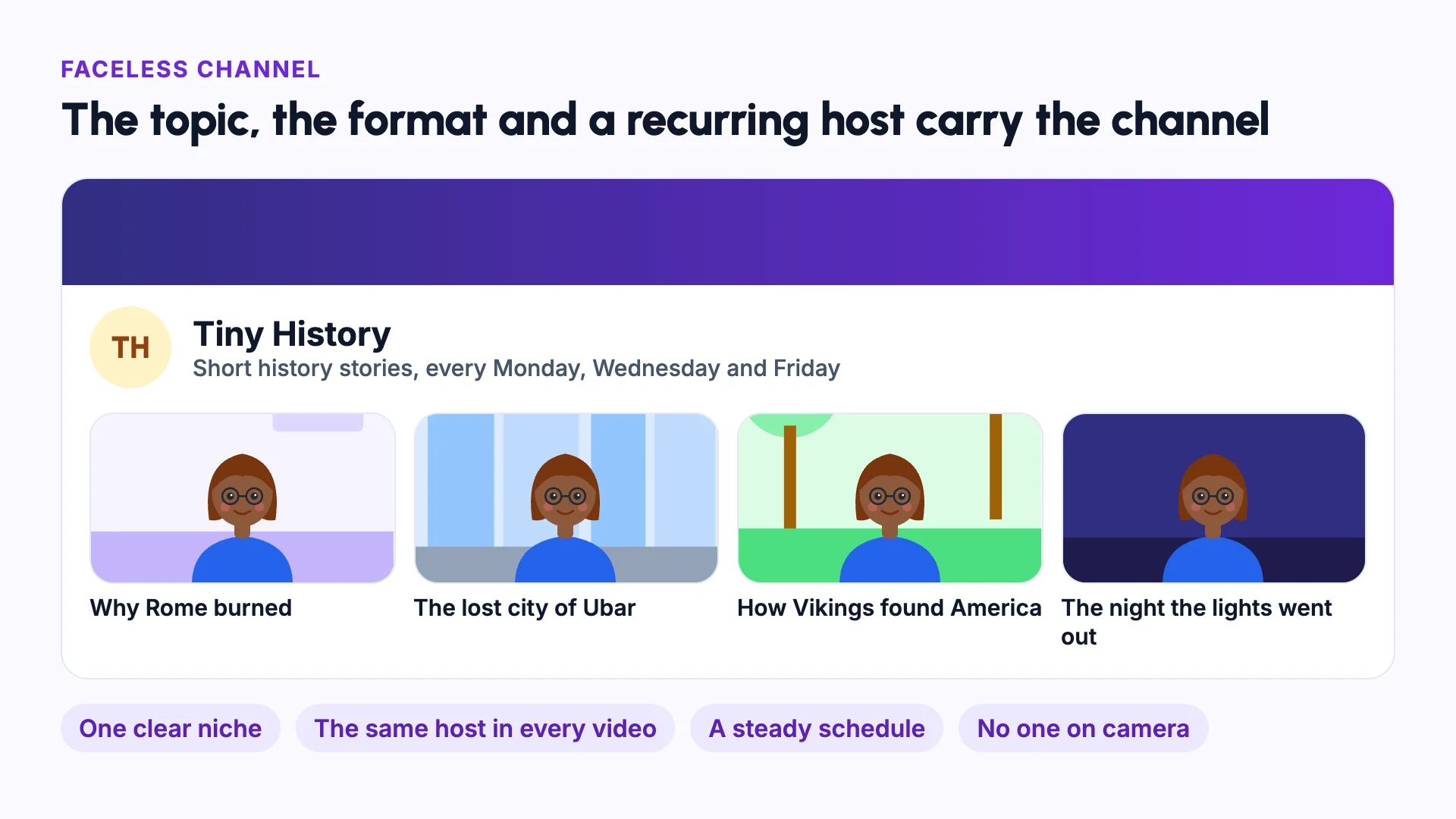
Tiny History is a made-up channel that tells one short history story three times a week. Each video opens with a question, like how a whole city could vanish for a thousand years.
Every video uses the same cartoon guide, the same narrator voice and the same caption style. A viewer who sees one thumbnail knows what the next video will feel like.
The topics change every time, but the format stays the same. That is what lets a faceless channel build an audience without a person on camera.
How faceless channels make money
Most faceless channels earn from ads through the YouTube Partner Program. To stay eligible, videos must follow YouTube's monetization policies, which do not pay for reused or mass-produced content.[1]
How much a channel earns per thousand views is called RPM. It depends on the niche and the audience. Finance and software topics usually earn more per view than entertainment.
- Ad revenue from long videos and Shorts.
- Sponsors that fit the niche.
- Affiliate links in the description.
- Selling your own products, like guides or courses.
Faceless channel vs personal brand channel
| Faceless channel | Personal brand channel | |
|---|---|---|
| Who viewers follow | The topic, the format and a recurring character | The creator as a person |
| On camera | No one | The creator, in most videos |
| Scaling | Easier to hand to writers and editors | Hard to scale beyond the creator's own time |
| Privacy | The creator stays anonymous | The creator is public |
| Risk | Easy to copy, so originality matters more | Depends on one person's health and schedule |
Common mistakes
Picking a niche only for its RPM
Choose a topic you can make a hundred videos about. A high RPM does not help if you run out of ideas after ten.
Copying a successful channel's videos
Use your own research, scripts and visuals. Near-copies can lose monetization.
Changing the format every week
Keep the voice, the captions and the host the same, so viewers recognise the channel.
Skipping the hook
Open every video with a question or a surprising fact. Viewers decide in the first seconds.
Posting without a schedule
Pick a pace you can keep, like two or three videos a week, and stick to it.
In Frameloop
How it works in Frameloop
- Frameloop makes faceless videos from an idea or a script, with AI images, AI animation or stock footage.
- Saved characters can appear in every video, which gives a faceless channel a recurring cast.
- Automations can make new videos on a schedule and auto-publish them to your YouTube channel.
- Voiceover and captions work in 32+ languages.
Questions people ask
Can faceless channels be monetized?
Yes. Faceless channels can join the YouTube Partner Program like any other channel. The videos must be original and follow YouTube's monetization policies.[1]
What are good niches for a faceless channel?
History, science, true crime, finance explainers, stories and tutorials are common. The best niche is one you can cover for a long time.
Do I need to show my voice?
No. Many faceless channels use an AI voiceover. Some creators record their own voice and still never appear on camera.
How long does it take to grow a faceless channel?
It varies a lot. Most channels need many videos before one takes off. A steady schedule and a clear format help.
Sources
- [1]YouTube channel monetization policies, YouTube Help