
Key takeaways
- 01You give a topic or a premise. AI writes the script.
- 02It is the fastest way to start, but you have less control over the words.
- 03Review the script and scenes before you publish.
Idea to video vs script to video
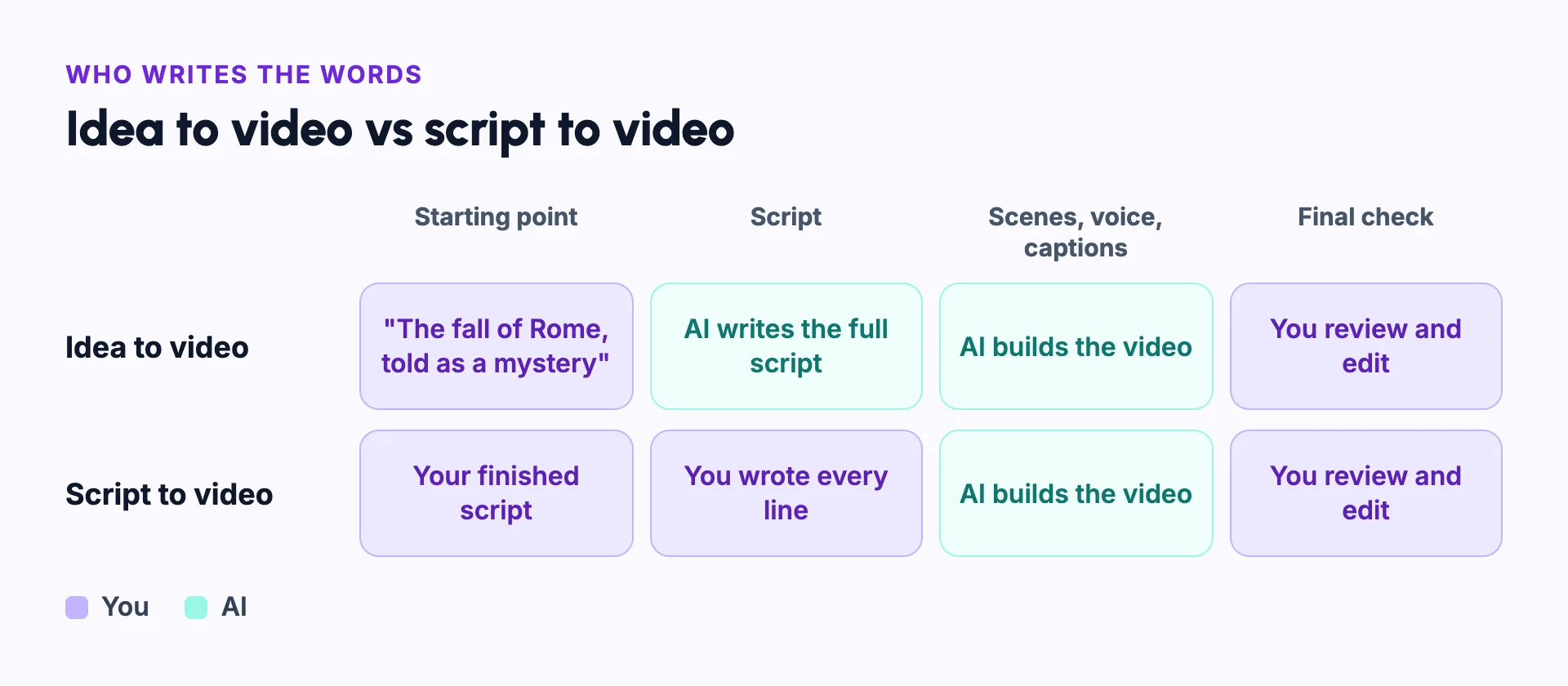
Both end with the same kind of video. The difference is who writes the words.
With script to video, you write every line. With idea to video, you write one line and the AI writes the rest.
Idea to video suits volume work, like a daily faceless channel. Script to video suits videos where every word matters, like a brand story.
How to write a good idea prompt
Be specific about the topic, the audience and the angle. "The fall of Rome for teenagers, told as a mystery" gives a better script than "Rome".
Say the length and the tone you want. Add a source page if the facts matter.
Example: from one line to a video
Idea: "The fall of Rome for teenagers, told as a mystery."
The AI writes a script that opens with a question, like how an empire that ruled for centuries could stop working. It then follows the clues: money troubles, a divided empire and invasions. Each clue becomes a scene.
You read the script before anything is generated. If the angle is wrong, you change one line of the idea instead of rewriting a whole script.
If one fact or line is weak, edit the script directly. You keep the speed of idea to video and still control the words that matter.
When to use idea to video
Idea to video is best when speed matters more than exact wording.
It is weaker when every word must be exact, such as product claims, legal text or a brand script. In those cases, write the script yourself, or treat the AI script as a first draft and rewrite it.
A good habit is to keep a list of ideas that worked. Reuse their pattern of audience, angle and length for the next video in the series.
- Daily or weekly series, like a faceless channel.
- Testing several topics before you commit to one.
- First drafts that you then edit as a script.
A weak idea vs a strong idea
| Weak idea | Strong idea | |
|---|---|---|
| Topic | Rome | The fall of Rome |
| Audience | Not stated | For teenagers |
| Angle | Not stated | Told as a mystery |
| Length and tone | Not stated | 60 seconds, curious and a little dramatic |
Common mistakes
Giving a one-word idea
Add the audience, the angle and the length. One clear sentence gives a far better script.
Skipping the script review
Read the script before the video is made. It is the cheapest place to fix the story.
Trusting every fact
AI can get facts wrong. Add a source page, and check names, dates and numbers.
Using the same idea pattern every time
Vary the angle and the format, so a series does not feel repetitive.
Expecting exact wording
If every word matters, write the script yourself and use script to video.
In Frameloop
How it works in Frameloop
- Write a one-line idea and Frameloop writes the script, then builds the narrated video.
- You can add a web page URL as context for the script.
- The Create Assistant can also take your idea in a chat, ask the needed questions and start the job after you approve.
- Every scene stays editable before you render.
Questions people ask
What is the difference between idea to video and script to video?
Who writes the words. In idea to video, AI writes the script from your one-line idea. In script to video, you write it.
Can I edit the script the AI writes?
Good tools let you review and change the script before the video is made, and edit scenes afterwards.
How specific should my idea be?
Name the topic, the audience, the angle and the length. One sentence is enough.
Is an AI-written script accurate?
Not always. AI can state wrong facts with confidence. Check names, dates and numbers, or give it a source page to work from.