
Key takeaways
- 01Narration is one voice telling the story. Dialogue is characters talking to each other.
- 02Each character needs a voice that stays the same for the whole video.
- 03Dialogue suits dramas, comedy skits and micro dramas.
Narration vs dialogue
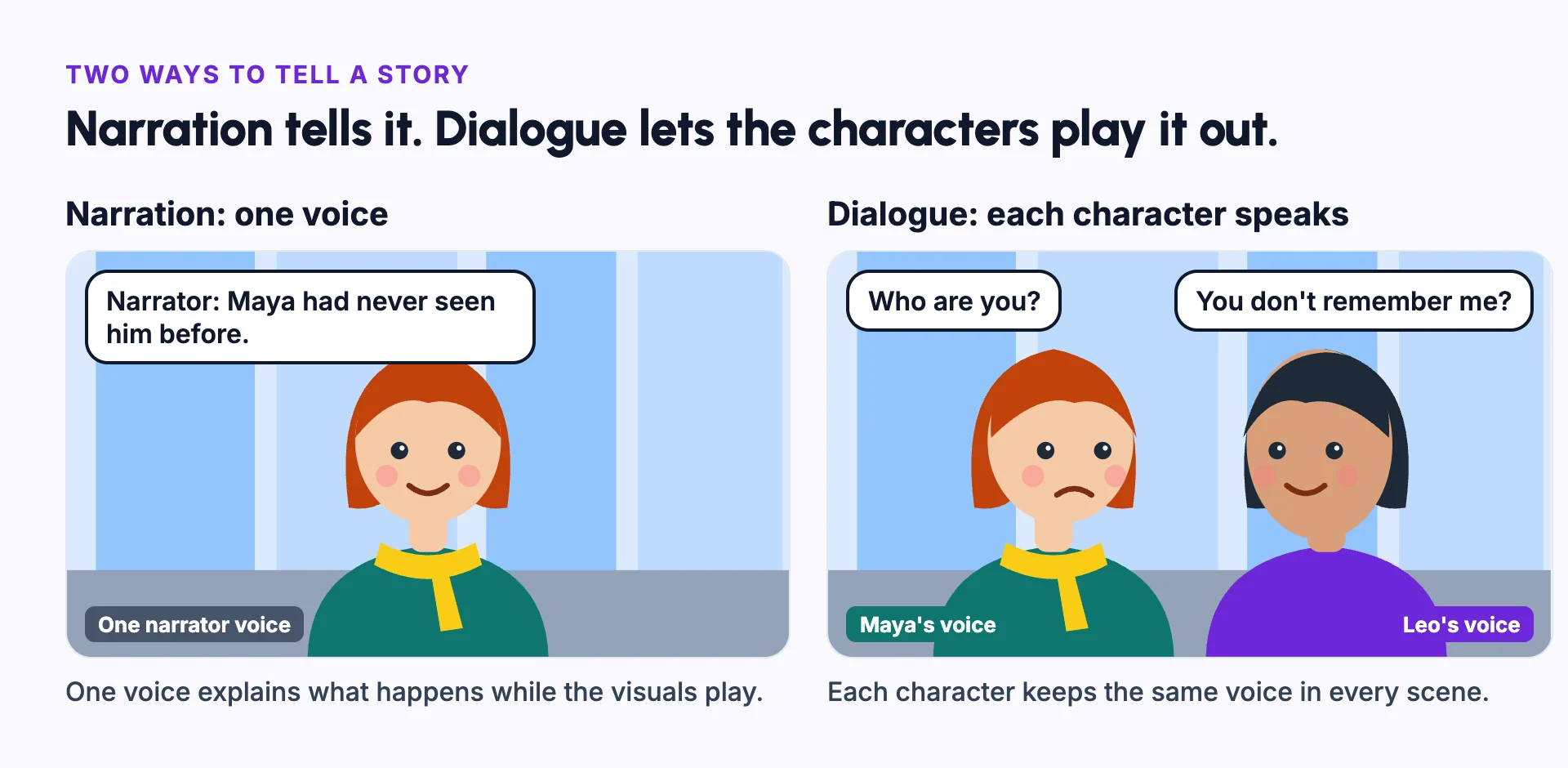
Most faceless videos use narration. One voice explains what is happening while the visuals play.
Dialogue shows the story instead of telling it. Characters argue, joke and react. This feels closer to a real film, and it suits drama, comedy and micro dramas.
What makes AI dialogue work
Each character needs their own voice, and that voice must not change between scenes.
The face must stay the same too, which is called character consistency. A character who looks different in every shot breaks the scene, even if the voice is right.
Short lines work better than long speeches. Real conversation moves fast.
Example: one scene, written both ways
Narration: "Maya had never seen him before. He said they had met as children, but she did not believe him."
Dialogue: Maya: "Who are you?" Leo: "You don't remember me?" Maya: "Should I?" Leo: "We grew up on the same street."
The dialogue version shows Maya's doubt instead of explaining it. It needs two steady voices and two consistent faces, but it plays like a film.
The narration version is faster to make and easier to follow on mute with captions. Pick the one that suits the platform and the story, not the one that looks more impressive.
How to write dialogue for AI video
- Write each line as one breath. Short lines are easier to voice and to time.
- Put the speaker's name before every line, so the right voice reads it.
- Show feeling through what characters say and do. A voice cannot act out stage directions.
- Keep each scene to two or three speakers.
- Read the lines aloud with a friend, or play them back with the chosen voices, before you build the scenes.
- Leave a short pause after a question or a surprise, so the other character's reaction can land.
When to use narration or dialogue
| Narration | Dialogue | |
|---|---|---|
| Best for | Explainers, documentaries and faceless channels | Dramas, comedy skits and micro dramas |
| Voices | One | One per character |
| Effort | Lower: one voice and simpler scenes | Higher: voices, faces and timing must all stay consistent |
| Feels like | A story being told | A scene being played |
Common mistakes
Writing long speeches
Real conversation moves fast. Break long lines into a back-and-forth.
Voices that change between scenes
Give each character one voice and keep it for the whole video or series.
Too many speakers in one scene
Viewers lose track of who is talking. Keep scenes to two or three people.
Mixing narration and dialogue without a plan
If you use both, keep the narrator for transitions and let the characters carry the scenes.
Silent mouths in close-ups
When the speaker's face fills the frame, use lip sync so the mouth matches the line.
In Frameloop
How it works in Frameloop
- AI Short Films turn a story or screenplay into a film where characters speak their own lines.
- Each character's voice stays the same across the whole film.
- You review the scene plan and the dialogue before anything is generated.
- AI Short Films need a paid plan, and film length depends on the plan.
Questions people ask
Can each AI character have its own voice?
Yes. Assign one voice per character and keep it the same for the whole video or series.
Is dialogue better than narration?
Neither is better. Narration suits explaining a topic. Dialogue suits drama and comedy, where characters drive the story.
Do characters need lip sync to talk?
Not always. Many scenes cut between faces and reactions. Lip sync matters most in close-ups of the speaker.
How long should dialogue lines be?
Short. One sentence or one breath per line keeps the scene moving and sounds natural.