
Key takeaways
- 01Episodes are very short and usually vertical.
- 02Every episode ends on a hook that pulls viewers into the next.
- 03The same cast must look the same in every episode.
How micro dramas work
Micro dramas grew on dedicated short-drama apps and as vertical videos on TikTok, YouTube Shorts and Reels. A full story is split into many short episodes, like an episodic series.
The stories are simple and emotional: romance, revenge, family secrets, sudden fortune. Each episode moves the plot forward fast and ends on a twist.
Anatomy of an episode
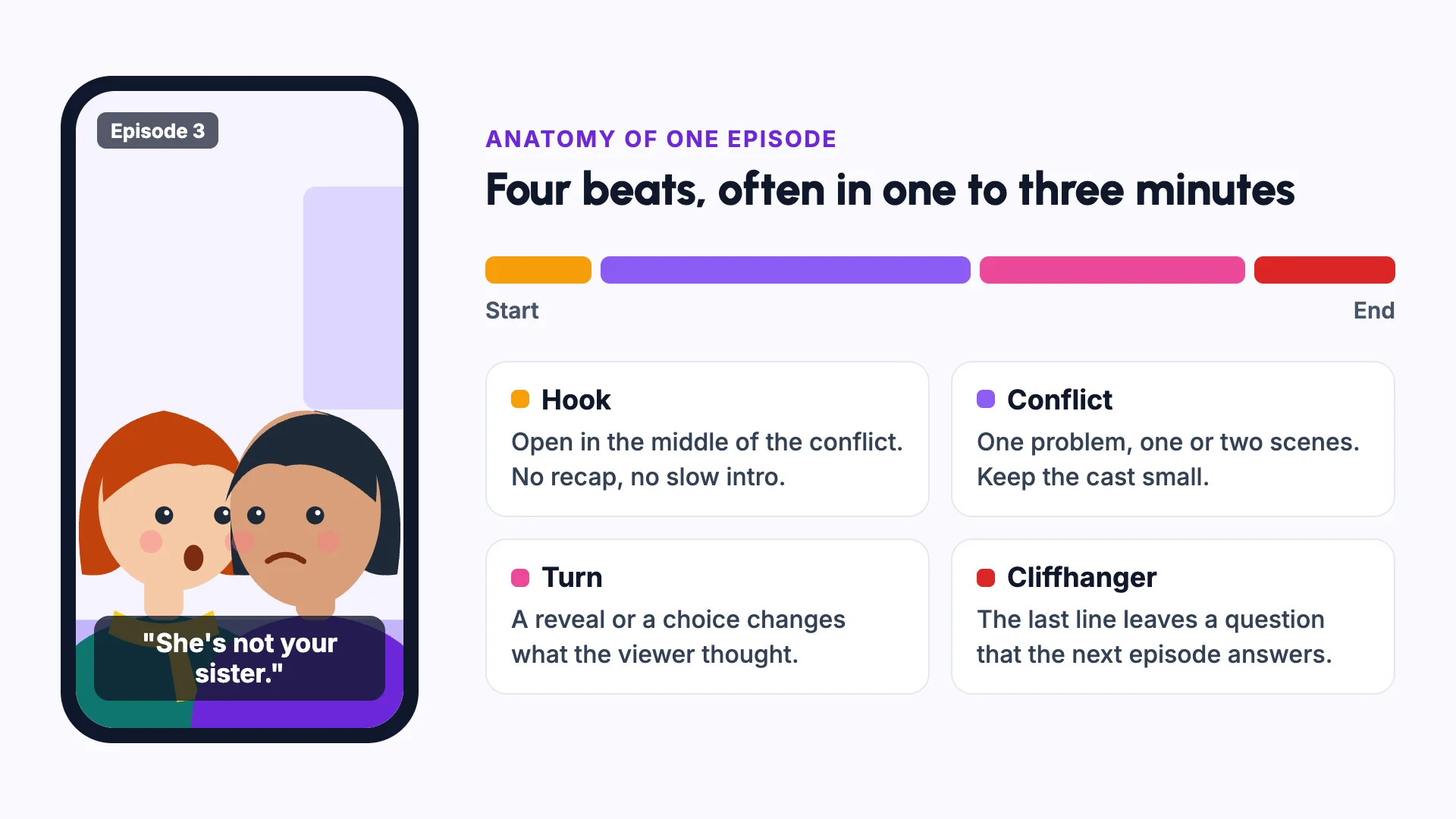
Most episodes follow four beats. A hook opens in the middle of the action. One conflict plays out in one or two scenes. A turn, like a reveal or a choice, changes what the viewer thought. The episode ends on a cliffhanger, often the last line of dialogue.
There is no time for a recap or a slow introduction. Viewers can swipe away at any moment, so every episode has to work for someone who just arrived.
How a season is planned
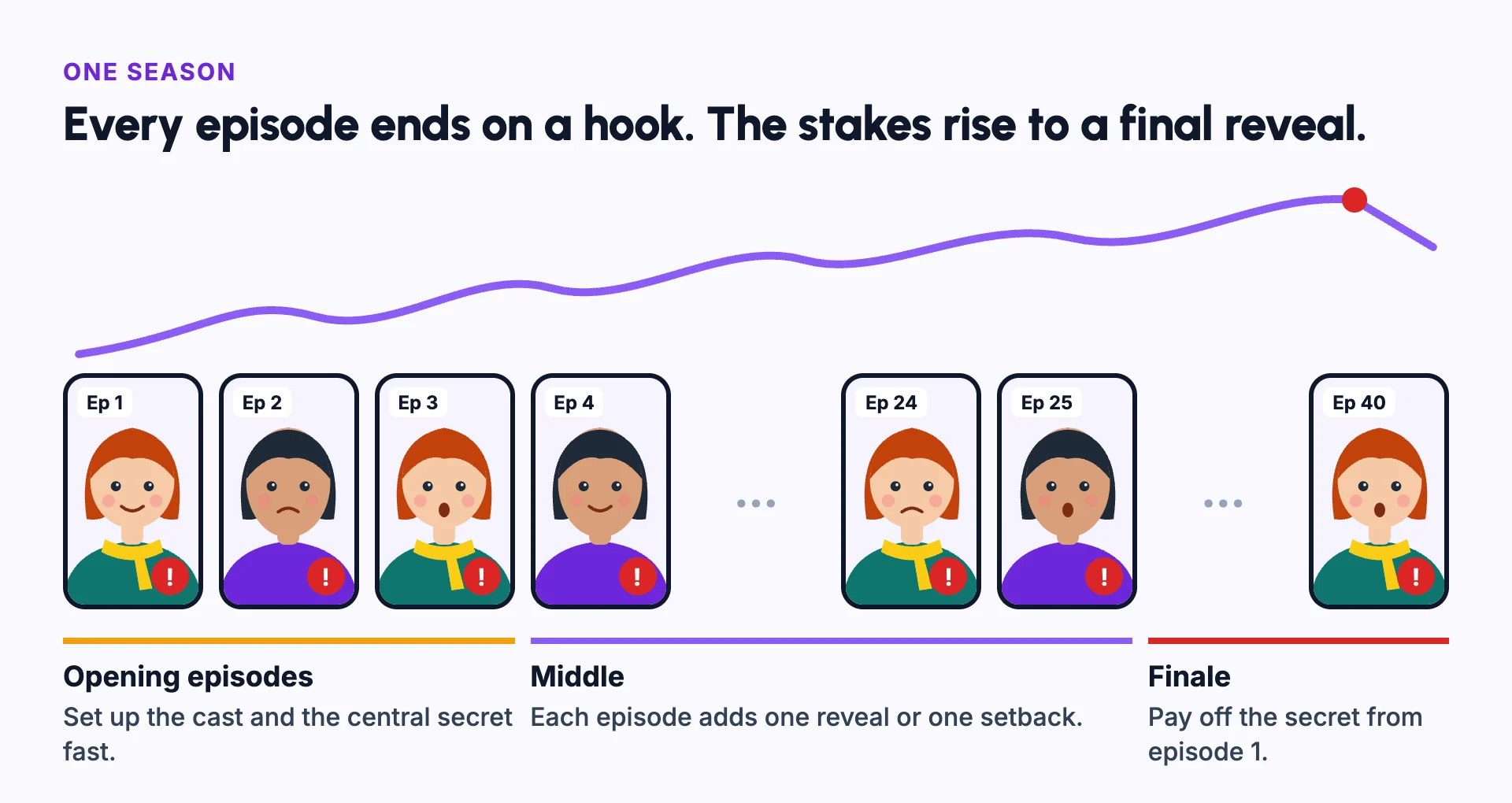
A micro drama is written as a full season, often dozens of episodes. Writers usually decide the big reveal first, then work backwards so each episode moves one step closer to it.
- Write a one-line summary for every episode before you write any scripts.
- Give each episode one reveal or one setback, not several.
- Keep the main cast small, with a character sheet for each person.
- Reuse a few locations, so viewers know where they are at once.
Example: the first three episodes
Here is an outline for a made-up story called The Wrong Wedding.
- Episode 1: Maya arrives at her sister's wedding and sees that the groom is her ex. Last line: "You didn't tell her about us?"
- Episode 2: The groom, Leo, begs Maya to keep quiet. She agrees, then finds a ring box with her own name inside.
- Episode 3: Maya confronts Leo in the hallway. He whispers the line that ends the episode: "She's not your sister."
Why micro dramas are hard to make with AI
A series can have dozens of episodes. The same characters must appear in all of them, with the same faces and voices.
Characters also need to talk to each other. A micro drama is dialogue, not narration.
Micro drama vs web series
| Micro drama | Web series | |
|---|---|---|
| Episode length | Often one to three minutes | Usually longer, from several minutes up |
| Screen | Vertical, made for a phone | Often horizontal, made for any screen |
| Episodes per story | Dozens | Usually a handful per season |
| Pacing | A twist in almost every episode | A slower build across the season |
| Where people watch | Short-drama apps, TikTok, YouTube Shorts and Reels | YouTube and streaming sites |
Common mistakes
A slow opening
Start in the middle of the conflict. Explain the background later, through dialogue.
Too many characters too early
Introduce two or three people first. Viewers need to know who to follow.
An episode that ends with everything settled
End on an open question: a reveal, a threat or a choice.
Faces that change between episodes
Reuse the same character references in every episode. Viewers notice when the lead looks different. See character consistency.
Framing for a wide screen
Plan every shot as vertical video. Keep faces in the centre and leave room for captions.
In Frameloop
How it works in Frameloop
- Make micro dramas and episodic series with the same cast in every episode.
- Saved characters look the same in every scene and episode.
- AI Short Films let characters speak their own lines, each in a voice that stays the same.
- Export vertical episodes for Shorts, Reels and TikTok.
Questions people ask
How long is a micro drama episode?
Usually about one to three minutes. Each episode needs room for a hook, a turn and a cliffhanger, so very short episodes are rare.
How many episodes does a micro drama have?
Often dozens. The story is split into many short episodes, and each one moves the plot forward by one step.
Where do people watch micro dramas?
On dedicated short-drama apps, and on short-form feeds like TikTok, YouTube Shorts and Instagram Reels.
Can you make a micro drama with AI?
Yes. The hard parts are keeping the same cast in every episode and letting characters speak their own lines. Look for tools that save characters and support dialogue.