

Avinash Vagh
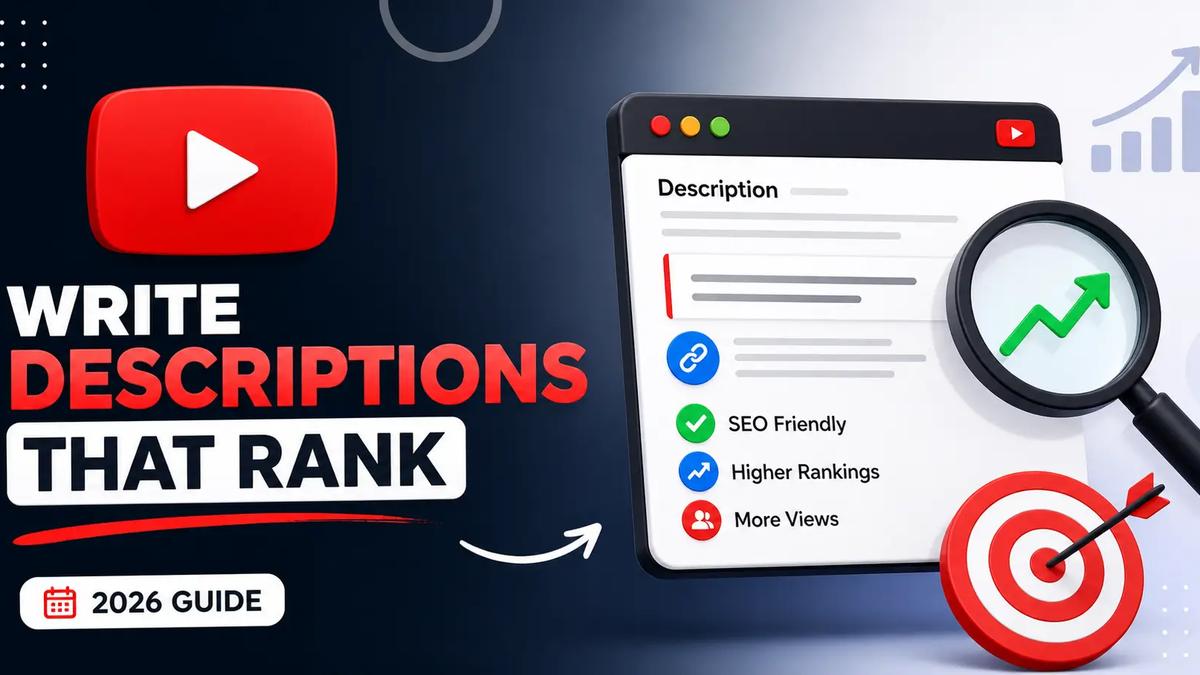
If your videos are getting impressions but not turning into views, there is a high chance your description is part of the problem.
Most creators focus heavily on thumbnails and titles. That makes sense because those are the first touchpoints. But once someone clicks or when YouTube tries to understand your video, your description starts doing real work.
It tells the algorithm what your video is about, how it connects to other content, and who should see it. At the same time, it helps viewers decide whether your content is worth their time.
The problem is not that creators ignore descriptions.
The problem is inconsistency.
You write a strong one today. Tomorrow you rush it. Next week you copy something generic just to upload faster. Over time, that inconsistency weakens your channel more than you expect.
That is exactly why tools like a YouTube description generator are becoming part of serious creator workflows not because writing is difficult, but because doing it well every single time is.
A YouTube description generator is a tool that helps you create structured, SEO-friendly descriptions based on your video topic, title, or keywords.
Instead of staring at a blank box, you input your idea and get a well-structured draft that already includes:
From there, you refine it.
The goal is not to replace your thinking. It is to remove friction.
If you want to see how it works, you can try a YouTube description generator and generate a complete draft in seconds.
The real benefit is consistency. Once you remove the effort of starting from zero, you are far more likely to maintain quality across every upload.
There is a common belief that descriptions do not matter anymore.
That is not accurate.
Descriptions are not the main ranking factor, but they are a supporting signal that helps YouTube understand your content better.
They influence:
When your description clearly explains your video, YouTube has an easier time categorizing and recommending it.
There is also a human layer.
Before someone clicks “show more,” they see the first two lines of your description. That small section can influence trust, clarity, and expectation.
If it feels vague or generic, it creates hesitation.
If it feels clear and aligned with your title, it builds confidence.
That alone can impact engagement.
A high-converting description does not try to impress with length or complexity.
It focuses on clarity.
It reinforces your title, expands on your topic, and guides the viewer toward the next step.
The best descriptions feel like a natural extension of the video itself.
They usually start with a strong opening that connects directly to the title. Then they explain what the viewer will learn, using keywords naturally instead of forcing them. Finally, they guide the viewes through links, recommendations, or calls to action.
This is where many creators miss the opportunity.
They treat descriptions as metadata.
In reality, descriptions are part of your funnel.
If you look at a wide range of videos, you will notice a pattern.
Some descriptions are too short to be useful. Others are overloaded with keywords and difficult to read.
Both approaches fail for the same reason.
There is no structure.
Without a consistent approach, descriptions become random. And random content rarely performs consistently.
That is why creators who grow over time rely on systems.
Whether it is a template or a YouTube description generator, the goal is the same to ensure every video follows a strong foundation.
Instead of guessing every time, follow a repeatable flow.
Start with the first two lines. These should clearly explain what your video offers and why it matters. This is the most important section because it is visible before expansion.
Then expand your topic. Describe what the viewer will learn and naturally include related keywords.
After that, guide the viewer. Add links to other videos, playlists, or tools that keep them engaged.
Finally, support discoverability by including keyword variations in a way that still feels natural.
Once you get used to this structure, writing descriptions becomes faster and more effective.
The biggest advantage of using a YouTube description generator is not automation.
It is consistency.
Instead of starting from scratch every time, you generate a structured draft and refine it. This reduces effort while maintaining quality.
It also fits well into a broader system.
Your title affects whether people click. Your description reinforces the value. Your hashtags help with discovery.
That is why many creators combine tools like an AI YouTube title generator to improve click-through rate, and a YouTube hashtag generator to improve reach.
When all three elements work together, your content becomes easier to scale without sacrificing quality.
This is one of the most important questions.
AI-generated content becomes generic only when it is used without editing.
The right approach is simple.
Use the generated output as a draft. Then rewrite the opening lines in your own tone. Adjust the structure if needed. Add your links and context.
This way, you keep the speed advantage while maintaining originality.
Over time, this becomes second nature.
Yes, and this is one of the easiest wins most creators ignore.
Your old videos already have data, impressions, and positioning within YouTube.
Improving their descriptions can:
This can increase visibility without creating new videos.
It is a low-effort, high-impact strategy.
Not every creator needs advanced systems from day one.
But there are clear situations where using a YouTube description generator makes sense.
If you are uploading frequently, maintaining quality manually becomes difficult.
If you are running a faceless channel, scalability depends on systems.
If your videos are getting impressions but low clicks, your description might be weakening trust.
If you are working with a team, consistency becomes essential.
In all these cases, using a structured workflow saves time and improves results.
A YouTube description is not just something you fill before publishing.
It is part of how your content gets understood, positioned, and distributed.
Ignoring it means losing small advantages that compound over time.
Using it intentionally gives your videos a better chance to perform.
A YouTube description generator is not about replacing creativity.
It is about supporting consistency.
And consistency is what drives long-term growth on YouTube.
If you want a faster and more structured way to write descriptions, start by using Frameloop’s YouTube description generator.
Once you combine better descriptions with stronger titles and hashtags, the improvement in your content quality becomes clear.

Got great video ideas but need help bringing them to life? Frameloop AI makes it easy to create professional faceless videos with AI-generated visuals, voiceovers, and editing.
Try Frameloop AI For Free