

Karunakar Gautam
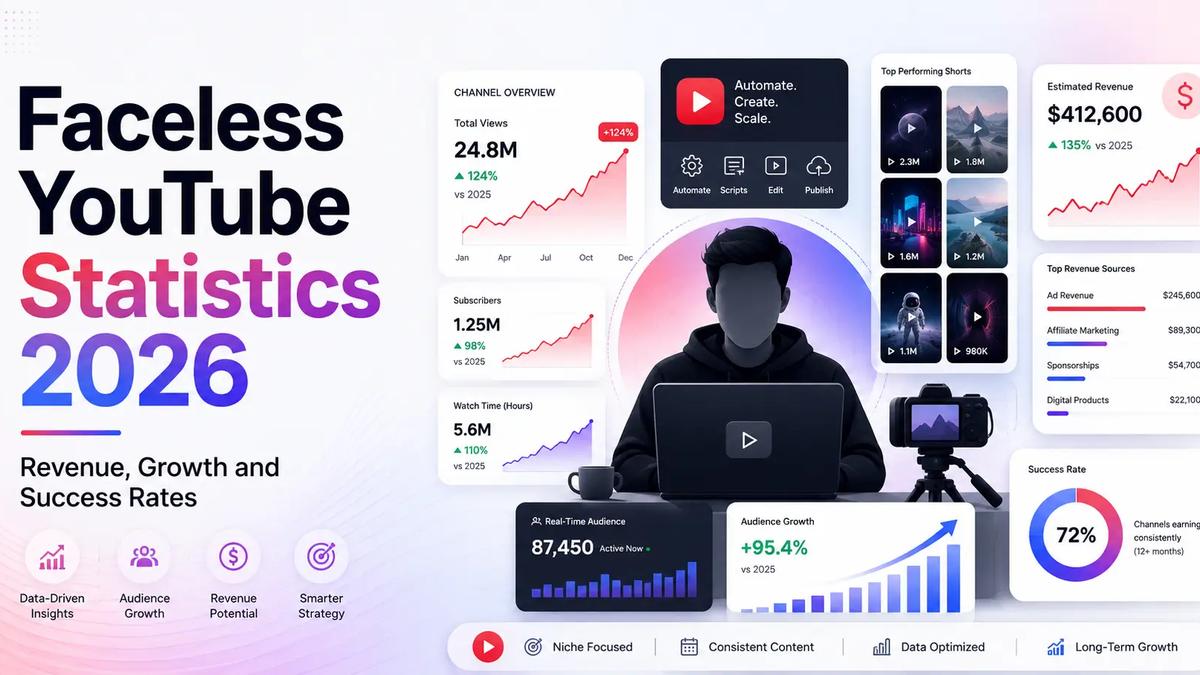
Faceless YouTube channels now account for 38% of all new creator monetization ventures in 2026, up from 12% in 2022, a 217% increase in three years, according to faceless creator industry data aggregated by AutoFaceless. The model has crossed from niche side hustle into a default content business, and the numbers behind it explain why a creator working alone can earn $5,000 to $50,000 per month without ever pointing a camera at their face.
This guide compiles the faceless YouTube statistics 2026 creators actually need: revenue ranges by niche and subscriber count, real success and failure rates, the time-to-monetization data nobody puts on the thumbnails, and the AI tooling shift that has compressed video production from a 4-hour-per-video grind to an afternoon's batch run.
The data tells two stories at once. Faceless is exploding, 200 billion daily Shorts views, $40.4 billion in YouTube ad revenue, a sub-$1,000 AI video market growing into a multi-billion-dollar category. And it is brutal, a 3% success rate, six-figure failures, and a quit point most creators hit just before the algorithm finally rewards them.
Start your faceless empire with Frameloop's AI faceless videos generator.
Key Takeaways
Faceless content is no longer a sub-genre; it is becoming the default mode of new channel creation. The 38% figure tracks new channels entering YouTube's Partner Program through faceless formats: voiceover-led explainers, animated documentaries, ambient livestreams, AI-narrated history channels, finance breakdowns, and short-form satire.
For context: YouTube has 2.7 billion monthly users in 2026, with over 1 billion hours of video watched per day. India leads with 509 million users, followed by the United States (248M), Brazil (147M), and Indonesia (139M). The platform's $40.4 billion in 2025 ad revenue exceeded Disney, NBCUniversal, Paramount, and Warner Bros. Discovery combined, and Goldman Sachs analysts project 2026 ad revenue between $44.5B and $46.2B as Shorts monetization expands and AI-optimized bidding matures.
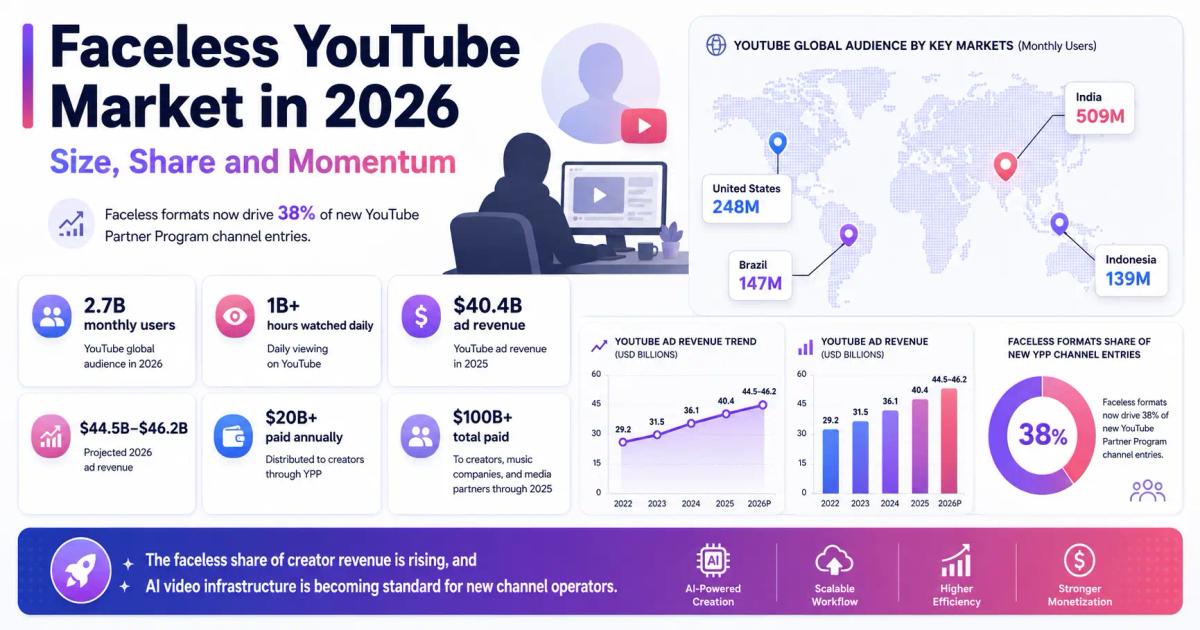
YouTube distributes over $20 billion annually to creators through the Partner Program, the largest creator monetization fund in digital video. The total paid to creators, music companies, and media partners crossed $100 billion through 2025. The faceless slice of that pie keeps growing, which is why a scene-based AI faceless video generator has become standard infrastructure for new operators entering the category.
Faceless videos accounted for more than 30% of viral content across YouTube, TikTok, and Instagram in 2023, and that percentage has climbed steadily through 2024 and 2025. The reasons are structural, not stylistic:
The faceless explosion is not an aesthetic preference. It is a business model with better unit economics than face-led content. That is what the next set of statistics measures.
Faceless YouTube growth tracks the AI video tooling curve almost one-for-one. Grand View Research values the global AI video generator market at $788.5 million in 2025 and projects $946.4 million for 2026, growing at a 20.3% CAGR to reach $3,441.6 million by 2033. Asia Pacific holds 31% of the market; North America leads adoption.
Adoption inside the creator base is moving faster than the overall market projection suggests. According to AI video generation statistics tracked by Adobe, AI video tool adoption has grown 342% year-over-year, and 42% of YouTube creators now use AI tools for editing, captions, or visual production. Nearly two-thirds of video marketers report using AI somewhere in their video pipeline.
The lesson: the rise of faceless YouTube and the rise of AI video tools are the same trend, observed from two different angles.
Revenue per faceless channel is a wide curve, not a number. The same workflow that produces a $200/month channel produces the $1.3M/month one, what changes is niche selection, production discipline, and the time the creator survives to compound.
Faceless channels in high-CPM niches consistently earn more per view than face channels in the same category. The aggregated 2026 ranges:
| Channel size | Niche | Monthly earnings (ads only) |
|---|---|---|
| 10,000 subscribers | Personal finance | $300–$1,500 |
| 100,000 subscribers | History / documentary | $1,500–$6,000 |
| 100,000 subscribers | Finance explainers | $5,000–$10,000+ |
| 500,000 subscribers | True crime | $5,000–$20,000 |
| 1,000,000+ subscribers | High-CPM faceless | $20,000–$80,000+ |
These ranges are AdSense only. Faceless channels that diversify into affiliates, sponsorships, and digital products typically report ad revenue as 30–50% of total income, so a $10,000/month AdSense channel often turns into $25,000–$40,000 once the full revenue mix is layered in.
The faceless model produces some of the largest channels on YouTube without any individual personality attached:
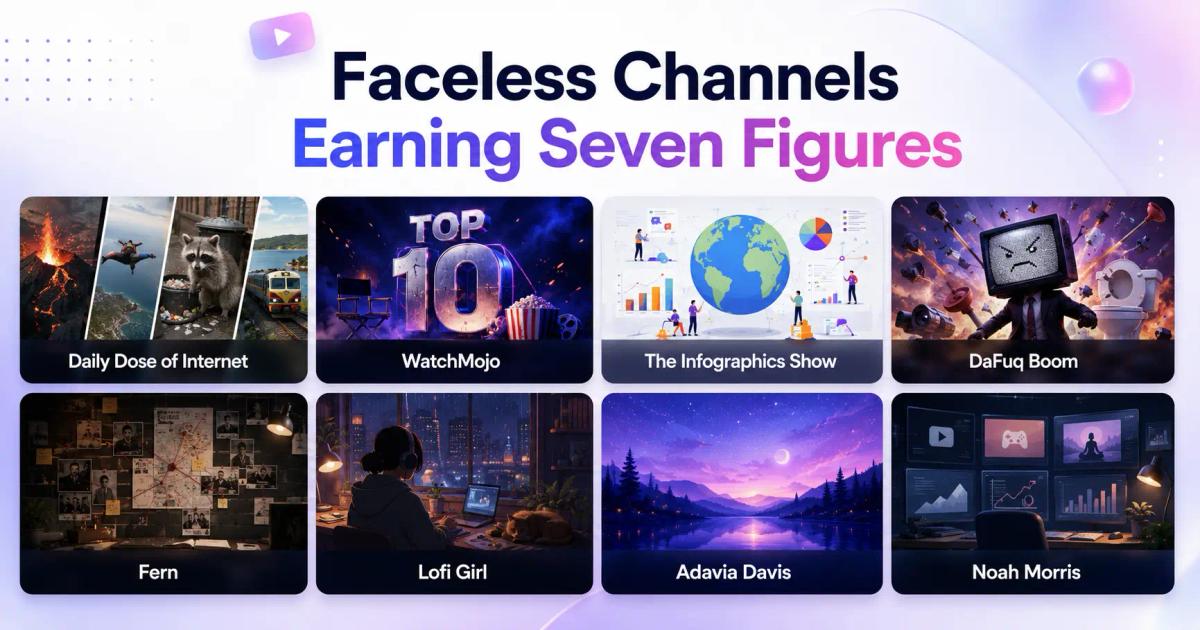
The DaFuq Boom number is the outlier ceiling, not the median. The Adavia Davis number ($40–60K/month from sleep audio) is closer to what a disciplined faceless operator can plausibly target inside three years. Channel revenue figures above are aggregated from 2026 faceless earnings breakdown and public Social Blade ranges.
CPM (advertiser cost per 1,000 views) and RPM (revenue per 1,000 views, after YouTube's 45% cut) determine ceiling earnings. The 2026 ranges, compiled from OutlierKit's profitable niche RPM datas.
| Niche | CPM range | Faceless RPM |
|---|---|---|
| Personal finance | $15–$22 (US viewers) | $10–$15 |
| Make money online | $15–$20 | $9–$14 |
| AI and technology | $15–$22 | $10–$15 |
| Faceless storytelling | $15–$25 | $9–$13 |
| Legal / court drama | $12–$18 | $8–$12 |
| Digital marketing | $12–$18 | $8–$12 |
| Educational explainers | $10–$25 | $7–$15 |
| Real estate | $10–$16 | $7–$11 |
| Health and wellness | $7–$20 | $5–$13 |
| True crime / documentary | $8–$15 | $4–$8 |
| Ambient soundscapes | $10–$20 | $6–$12 |
| Faceless gaming | $4–$15 | $3–$10 |
| Entertainment / memes | $2–$6 | $1–$3 |
The "make money online" niche carries a documented $13.52 average CPM, meaning a faceless channel doing 10,000 views per video can target roughly $4,056 per month in AdSense once a regular publishing cadence is established. That math is what makes the niche dominant.
The flip side: a faceless Shorts-only channel in entertainment runs CPMs around $0.10 versus a long-form finance video at $20. That is roughly a 200x difference for the same view count. Niche selection is the single largest revenue lever a faceless creator controls.
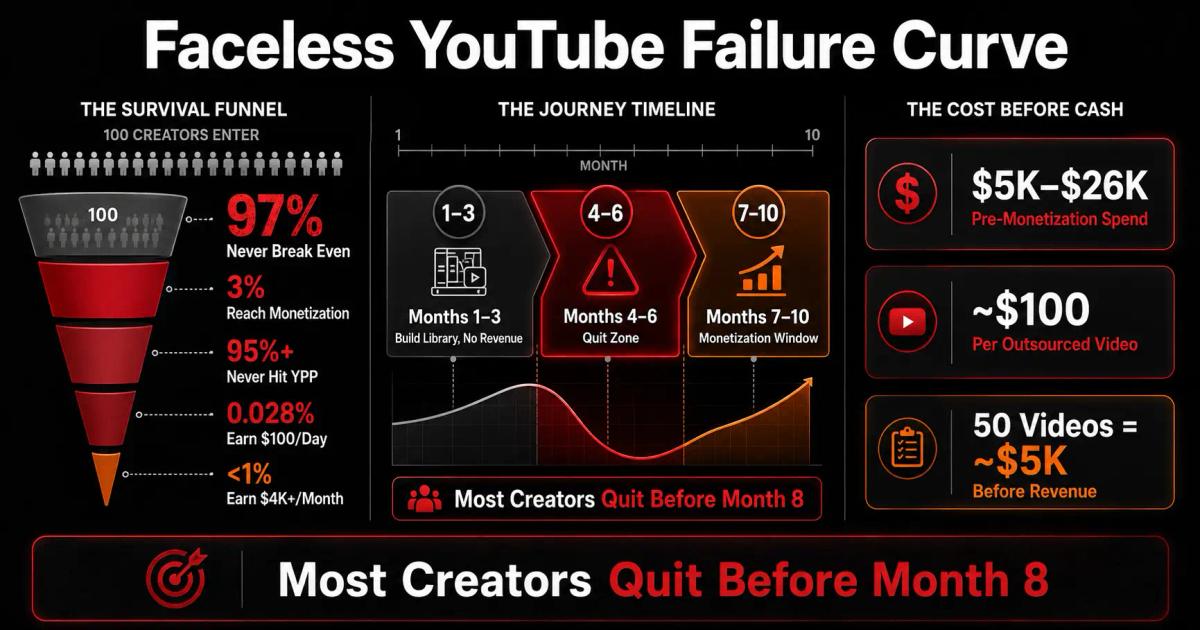
The faceless model has a survival curve that is much harder than the success stories imply. The aggregated 2026 numbers from Frameloop's YouTube automation statistics report:
The 3% number is specifically for faceless automation channels; the broader 95% non-monetization figure covers every channel category. Both numbers should be sitting in a creator's head before they start, not after.
The single most consistent finding across faceless creator timeline data: the vast majority of channels that ever monetize do so between months 7 and 10, and the vast majority of channels that quit do so between months 4 and 6, right before the inflection point.
Months 1–3 are pre-revenue. Production library is being built, formats are being tested, most videos earn under 100 views, and creators spend $200–$2,000/month with zero return. Months 4–6 feel identical to months 1–3 from the creator's seat, same views, same revenue, same effort. Creators who quit in this window never see what month 8 looks like.
That gap is where the algorithm starts compounding. A 30-video library hits enough sessions watch history to be recommended consistently. Average watch time crosses thresholds that move videos from "Suggested" to "Browse." Subscriber velocity starts feeding back into impressions. None of it is visible until it happens. This is the exact pattern documented across multi-channel operations covered in the Frameloop faceless YouTube automation guide, where the survivors are the operators with a batch-production system already in place before month 6.
Faceless YouTube is not a free side hustle. The 2026 documented investment ranges:
A single video, fully outsourced, costs about $100. A 50-video library, the size that often unlocks algorithmic compounding, runs $5,000 before the channel earns a dollar.
This is why AI video tools have become structurally important to the faceless economy. A scene-based AI video editor compresses the per-video production cost by 70–90% and turns the 4.5-hour-per-video median into an afternoon's batch. Frameloop's scene-based editor was built around exactly this gap, give a faceless creator the per-scene control that previously required a freelance editor, but compress the workflow into something a single operator can run weekly.
The 97% failure pattern is rarely about effort. It is about four predictable mistakes:
Niche selection on vibes: starting a motivational Shorts channel because it looks easy, when CPM economics make a $400 month nearly impossible at that view count
Underestimated capital: planning for "free YouTube" when reality is $5,000+ in upfront production
Quality outsourcing without QC: AI-generated scripts dropping engagement 37%, outsourced thumbnails dropping CTR by 50%
Quitting before month 8: 60–80% of eventual monetizers cross the line between months 7–10; nobody who quits at month 5 ever finds out
The growth story is harder to overstate. YouTube Shorts has scaled in 24 months in a way that fundamentally rewards faceless content formats, voiceover-led, animated, narration-first, or visual-loop.
For faceless creators, Shorts are the discovery layer and long-form is the monetization layer. The combination is not optional. A 2026 faceless channel that only posts long-form will grow roughly half as fast as a channel running both, and one that only posts Shorts will earn roughly a 95% lower CPM on identical views.
Faceless content has format-specific advantages that the algorithm has rewarded through 2025 and into 2026:
The 18x AI/tech growth is the standout. Faceless tech tutorials work for a structural reason: viewers want clear screen recordings, voiceover, and depth, none of which require a face. The category is also evergreen, since tools update monthly and tutorial demand is continuous.
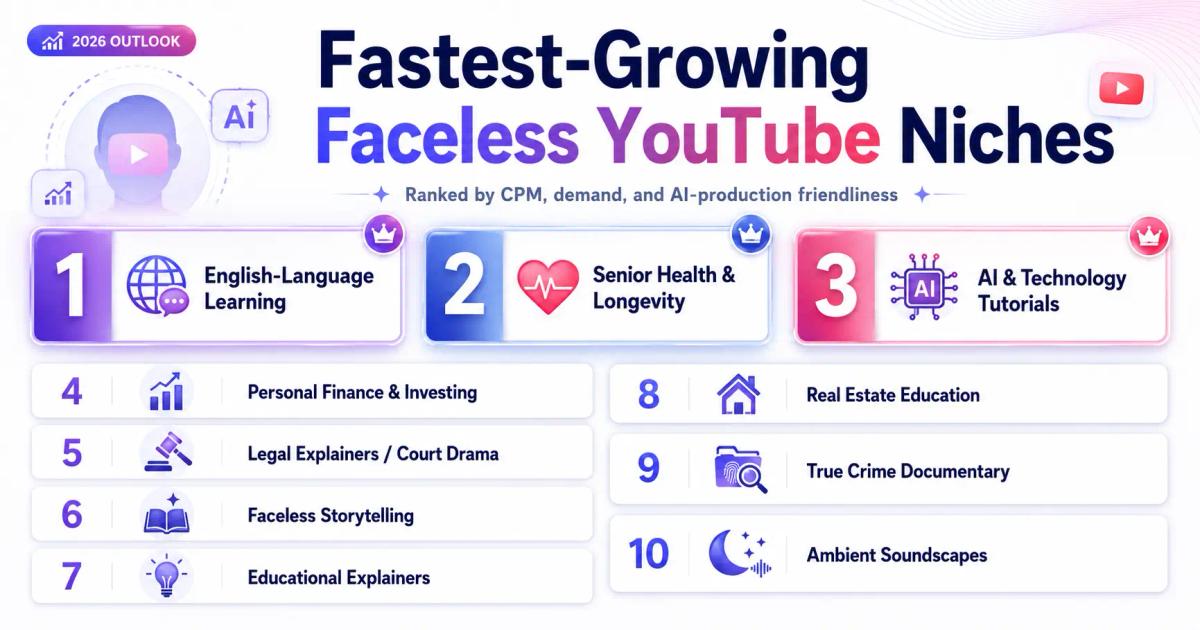
OutlierKit's profitable niche rankings and Tubular Labs' social video trends report rank the following faceless categories as the fastest-growing combinations of CPM, demand, and AI-production friendliness:
Personal finance and investing ($15–$50 CPM, high competition, sub-niche opportunity)
AI and technology tutorials ($15–$22 CPM, medium competition, 18x growth)
Faceless storytelling ($15–$25 CPM, medium competition)
Educational explainers ($10–$25 CPM, medium competition)
Senior health and longevity ($7–$20 CPM, low competition, 19x growth)
Legal explainers / court drama ($12–$18 CPM, low competition)
English-language learning (21x growth, global audience)
Real estate education ($10–$16 CPM, high intent)
Ambient soundscapes ($10–$20 CPM, low competition, sleep niche)
True crime documentary ($8–$15 CPM, high view counts)
Sub-niche selection inside these categories is where new channels in 2026 are still finding low-competition entry points, personal finance for nurses, AI tools for accountants, legal explainers for landlords, ambient audio for ADHD focus. Frameloop's AI faceless video idea generator produces niche-specific topic batches in seconds, which removes the blank-page problem most channels hit in week one.
The biggest question creators ask before starting a faceless channel: does the audience actually trust content without a face? The 2026 data says yes, with a meaningful caveat.
The reconciliation: viewer trust is not about whether they see a face. It is about whether they can tell the content is generic. AI slop with no editorial control loses trust. Faceless content with a real editorial perspective, consistent production quality, and a clear point of view earns trust on par with face channels.
This is the structural argument for AI video tools that preserve creative control instead of automating it away. A faceless creator using a scene-based AI editor like Frameloop decides the hook, the script tone, the pacing per scene, and the voiceover style. The output reflects creator decisions, not platform defaults. That is what 86% of consumers identify as "authentic", even when no face appears.
The cost data behind the faceless explosion, aggregated 2026 creator statistics:
The 58% lower production cost is the structural advantage. Add the 32+ language voiceover replication that AI tooling unlocks, and a single faceless concept can run across multiple regional channels with the same script. That is how Noah Morris operates 20 channels at once.
The 2026 faceless YouTube economy runs on AI video infrastructure that did not exist at scale before 2024. The shift is what made the 38% market share possible.
Pre-AI faceless workflow (2022 baseline):
2026 AI faceless workflow with a scene-based editor:
That shift is the entire reason a single operator can run multiple channels. It is also why the 96% failure rate is shrinking, the bar to publish 30 videos in three months has dropped from "near impossible without a team" to "one Sunday afternoon."
Frameloop's scene-based faceless videos generator was built around this workflow. Each scene is independent, change scene 3 without re-rendering scenes 1, 2, and 4. AI voiceover in 32+ languages, swappable in 2 clicks per scene. Free tier with no credit card and no watermark, so testing 10 videos costs nothing. That is the production stack the 38% of new faceless creators in 2026 are running.
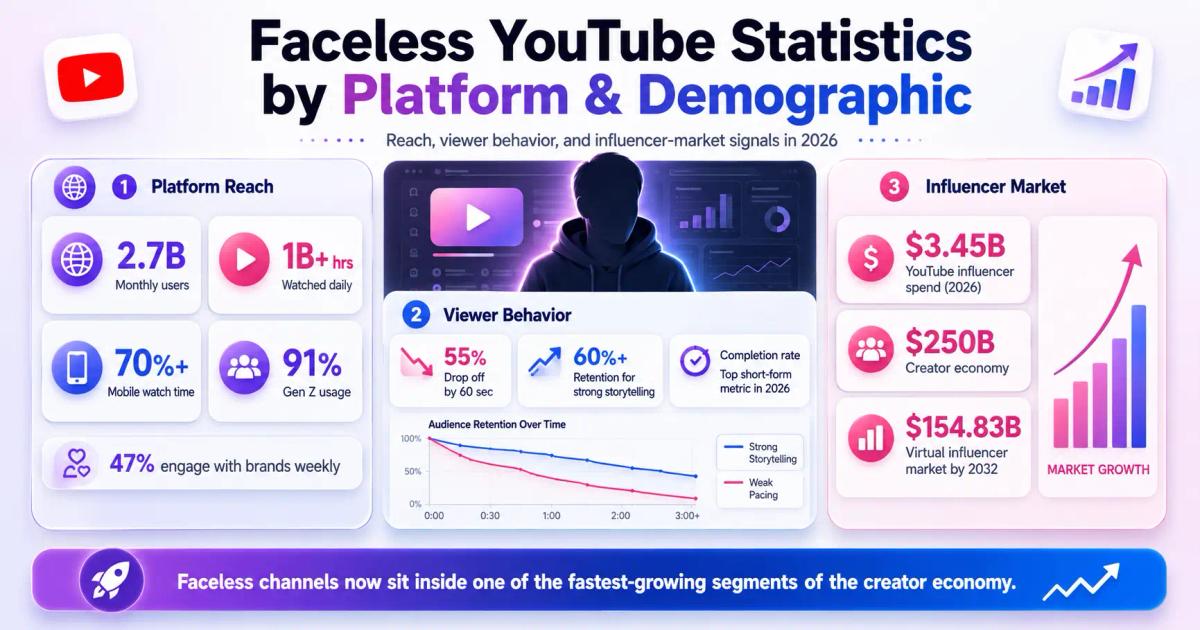
A few additional data points worth keeping in view when planning a 2026 faceless channel:
A faceless channel today is not just a YouTube revenue play. It is positioned inside the fastest-growing segment of the broader influencer economy.
The numbers say three things clearly:
The model works. 38% market share, $40B in YouTube ad revenue, $100B+ paid to creators historically, faceless channels regularly clearing five and six figures monthly. The opportunity is real.
The bar is higher than the hype implies. A 3% success rate, $5,000–$26,000 in pre-monetization investment, and 7–10 months before the algorithm rewards consistency. Faceless YouTube is a 12–24 month bet, not a side hustle.
AI tooling is the structural advantage. Faceless creators using scene-based AI editors compress per-video production by 70–90% and turn the 50-video library threshold from "team project" into "one Sunday afternoon batch." That changes the failure math.
The creators winning in 2026 are not the ones who started earliest or had the biggest budget. They are the ones who picked a high-CPM niche, batch-produced 30+ videos with AI tooling before quitting was even an option, and survived the months 4–6 stretch where every other channel taps out.
If you are starting a faceless channel in 2026, three decisions move the math more than anything else: niche (finance / AI / legal / faceless storytelling), production system (a scene-based AI editor that lets you batch and control output per scene), and upload cadence (12+ per month, Shorts + long-form combined).

Frameloop was built by a ex-employee from Google and Adobe to handle the production half of that equation. Scene-based editing means you control every scene independently, change scene 3 without re-rendering the rest. 32+ language AI voiceover lets a single faceless concept run across multiple regional markets. The free tier requires no credit card and adds no watermark, so testing 10 videos against your niche hypothesis costs nothing.
Start your faceless empire with Frameloop's AI faceless videos generator.
The faceless YouTube statistics in 2026 reward creators who treat the channel like a business: capitalized, niche-selected, batch-produced, and patient through month 8. The 3% of channels that monetize are not lucky. They are the ones who survived the math the other 97% never measured.

Got great video ideas but need help bringing them to life? Frameloop AI makes it easy to create professional faceless videos with AI-generated visuals, voiceovers, and editing.
Try Frameloop AI For Free