

Avinash Vagh
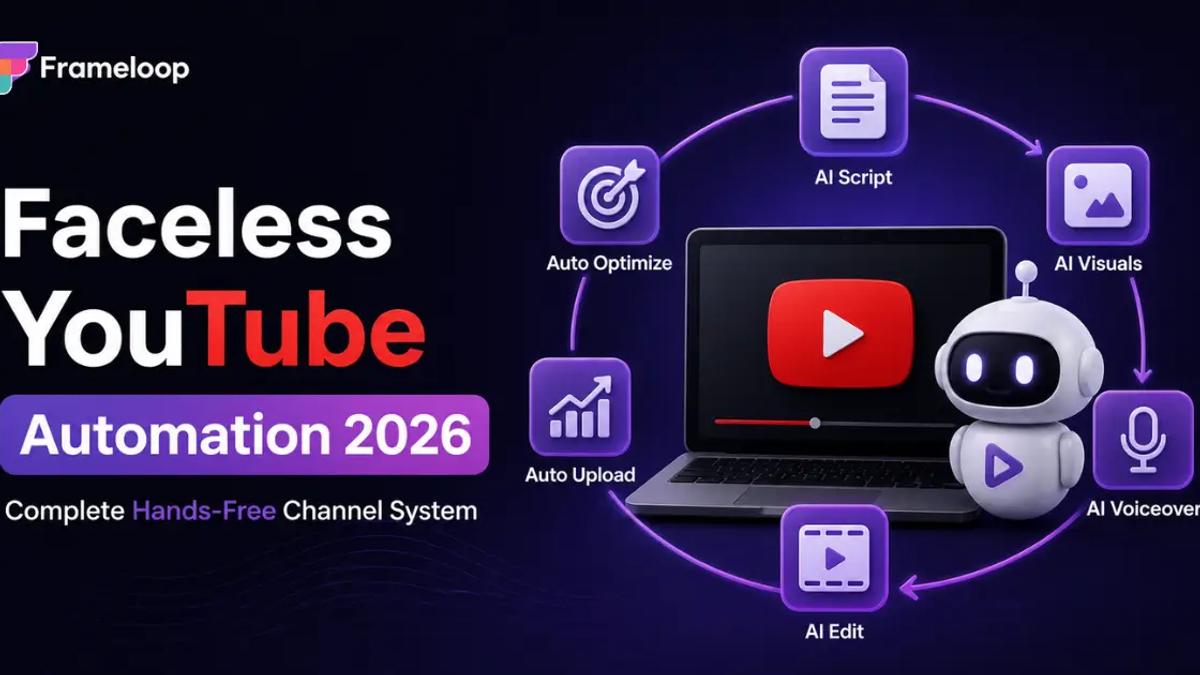
Faceless YouTube automation in 2026 means producing videos without appearing on camera, using AI to handle scripts, visuals, and voiceover, then running that content through a batch production system that fills a week of uploads in one sitting. The concept is straightforward. The execution is where most channels fail.
Most creators who try full automation end up with channels that look identical to 50 others. The automated content is generic, the hooks are interchangeable, and growth stalls at a few hundred subscribers despite months of consistent output. The problem is not the concept. It is the tool choice and the absence of a real system behind it.
Full-autopilot tools strip away the control that makes a channel worth watching. Traditional YouTube, on the other hand, demands your face on screen, daily energy, and 4 to 8 hours per video. Neither extreme works for someone building a hands-free channel meant to grow and monetize without constant attention.
This guide covers the complete 2026 system: the right tool stack, the weekly batch production workflow that produces 30 videos in one session, the hook testing approach that actually moves CTR, and the growth tactics most automated channels never touch.
Start your faceless channel with Frameloop's faceless video generator, no credit card, no watermark.
Key Takeaways
Faceless YouTube automation is the practice of producing YouTube content without appearing on camera, using AI tools to handle every production step, and running that workflow on a repeatable weekly cadence rather than daily manual effort.
The definition has stayed consistent. What changed in 2026 is the split between two fundamentally different approaches to automation.
Full autopilot tools accept a single input, a topic, a keyword, or a rough script, and deliver a complete video with no further decisions required. Type "10 tips for beginner investors" and the tool produces a finished video with AI visuals, AI voiceover, and auto-generated captions.
The problem: every creator using that same tool on that same topic gets a video that looks nearly identical. The hook visual is generic. The voiceover cadence is recognizably synthetic. The scenes have no variation because the tool generated everything from one prompt, one aesthetic, one output run.
Controlled automation restores creative direction without sacrificing speed. You still write or generate a script. The AI still handles visuals and voiceover. But each scene is independently editable. You can change scene 1's visual without touching scenes 2 through 8. You can test three different hook styles for the same script. You can adjust pacing on the explanation scene without regenerating the entire video from scratch.
That structural difference determines whether your automated channel builds an audience or stalls permanently.
A functioning automated faceless channel requires three things operating together:
A video creation tool with scene-level control. Not prompt-to-output. Scene-by-scene editing that preserves production speed while giving you creative direction over what viewers actually see in each moment.
A batch production cadence. One session per week that produces a full week's content, not one video at a time. Thirty videos in a Sunday session, scheduled for daily upload, means your channel keeps posting while you work on something else.
A systematic approach to hook testing. Not publishing and hoping. Creating multiple hook variations per script, reading the CTR data at 48 hours, and applying that learning to the next batch. Volume without feedback is just noise.
Without all three, you have partial automation that produces content but not growth.
James started a personal finance channel in February 2026. He picked a niche with search volume, signed up for a full-autopilot tool, and set it to generate three videos per week from topics he supplied. By May, his channel had 214 subscribers and average CTR below 1%.
The content was technically accurate. The production schedule was consistent. But viewers were not clicking and not staying. James had built an automated channel that worked mechanically, and it was failing to grow anyway.
The three reasons his channel stalled are the same reasons most automated faceless channels plateau.
Full-autopilot tools generate the same category of visual for the same category of topic. Every financial explainer gets the same stock-style animated graphics. Every tech review gets similar B-roll-style shots. When your video appears in search results next to ten others covering the same topic, there is no visual or tonal reason to click yours over anyone else's.
The fix is scene-level control. When you can adjust the hook scene's visual independently, you make your thumbnail and first three seconds distinctly yours. That visual specificity is what drives CTR before a viewer commits to watching.
Most automated channel creators publish one version of each video and move on. This treats the hook as something fixed when it is one of the highest-impact variables in channel performance.
A channel using controlled automation can produce three versions of the same video, same script, same explanation section, different hook scene, different opening visual, different first five seconds. Upload all three. The one with the highest CTR tells you what your specific audience responds to. Apply that learning to the next batch.
Full-autopilot tools make hook testing impossible because regenerating the hook means regenerating the entire video.
Some automated channels use AI-generated characters or consistent visual styles as their brand identity. The channel becomes recognizable by its visual signature rather than by a face on screen. This approach works, but only if the visual style stays consistent across videos.
Full-autopilot tools have no mechanism for visual continuity across separate generation runs. Each video produces a slightly different treatment of the same style because the generation process has no memory of prior outputs.
Scene-based editors with saved visual parameters maintain consistency across a full channel. Your channel's visual identity stays stable whether you are on video 5 or video 300.
Not every tool in this category earns a place in a serious automated channel workflow. Here is what the actual 2026 stack looks like.
Frameloop is the faceless video generator built for the controlled automation model. The scene-based editor generates visual treatments for each scene of your script independently, so you have per-scene creative direction without per-video production overhead.
The workflow: paste your script, let the AI generate visuals scene by scene, adjust any scene that does not match your intent, add AI voiceover in 32+ languages, export as MP4 with no watermark. A 90-second video takes under 10 minutes once you know the tool. A 30-video batch session takes one Sunday afternoon.
Over 35,000 creators use Frameloop's scene-based workflow for exactly this. Free tier includes the full scene-based editor with no watermark on exports. No credit card required.
Frameloop includes a built-in AI script generator. Type a topic and it produces a hook-first short-form script structured for YouTube Shorts, TikTok, or Instagram Reels. For longer-form content, write in any text editor and paste directly into Frameloop's input field.
For topic ideation before scripting, Frameloop's AI faceless video idea generator surfaces niche-specific video topics with search demand signals attached, so you are not starting from a blank page on Sunday morning.
After export, schedule through YouTube Studio's built-in scheduler. TubeBuddy handles bulk scheduling if you are uploading 30 videos at once. Tools like Later, Buffer, and SocialEZ help creators distribute Shorts, TikTok videos, and Reels across multiple platforms from a single workflow.
The scheduling step is where the batch production model compounds its value. Thirty exported videos, scheduled across thirty days, is a month of daily uploads configured in one afternoon.
This is the actual workflow for running a faceless channel that produces consistently without requiring daily work.
Priya runs a personal development channel she built entirely on the Sunday batch system. In January 2026, she was posting sporadically and averaging 400 views per video. After switching to the Sunday system in February, she posted daily. By April, her channel crossed 28,000 subscribers and her videos were pulling 4,000 to 12,000 views each. The content itself did not change substantially. The system did.
The Sunday batch production system runs on a three-hour block.
Hour 1: Topic selection and scripting (60 minutes)
Open Frameloop's AI faceless video idea generator and pull 30 topic ideas for your niche. Filter for search demand and relevance to your channel's focus. Generate scripts for all 30 using the built-in script generator. Review each script for hook quality, voice accuracy, and factual correctness. At roughly two minutes per script, this takes 60 minutes for 30 scripts.
Hour 2: Video generation (60 minutes)
Paste each script into Frameloop sequentially. Let the AI generate visual treatments per scene. For most scripts in a consistent niche, the generated output needs only one or two scene adjustments before it is ready to export. Target two minutes per video for generation plus light editing. Thirty videos, 60 minutes.
Hour 3: Voiceover, export, and scheduling (60 minutes)
Add AI voiceover in your target language. Export each video as MP4. Schedule in YouTube Studio. Bulk scheduling 30 videos at two minutes each is 60 minutes. By the end of hour 3, your channel's next 30 days are loaded and scheduled.
For the full mechanics of batch creation at scale, the bulk AI video creation workflow covers the production detail.
Within your 30-video batch, select five scripts for hook variation testing. For each of those five scripts, generate two additional hook scenes in Frameloop. Scene 1 only changes; scenes 2 through the end stay identical. You now have three versions of the same video with different opening visuals and different first five seconds.
Upload all three. Check CTR at 48 hours. The version with the highest CTR tells you which visual style and opening narrative your audience clicks. Apply that signal to the next batch.
Over 12 weeks of batch production and hook testing, you build a specific data set about your audience's preferences. That data makes every subsequent batch sharper without requiring more work per video.
After each batch, review the prior batch's performance before building the next one. Three numbers matter:
CTR: Below 3% means your hook or thumbnail is not creating enough pull. Above 6% on a Short signals a format or framing to replicate across more videos in the batch.
Average view duration: Below 40% retention on a 60-second Short points to a scripting problem, not a production problem. The viewer clicked, which means the hook worked. The script did not deliver on what the hook promised.
Traffic source split: Most traffic coming from YouTube Search means you are ranking but not being recommended. Recommendation traffic signals strong audience retention signals that the algorithm is reading as quality content worth surfacing to new viewers.
The batch production system keeps a channel consistent. These are the levers that compound the numbers faster than consistency alone.
Only 17% of internet users speak English as their primary language (W3Techs). A faceless channel producing content only in English is competing in the most saturated, highest-competition segment of YouTube. The same content in Spanish, Hindi, or Portuguese reaches audiences that are proportionally far less served by existing creator content.
Frameloop generates AI voiceover in 32+ languages. Switching a video from English voiceover to Hindi takes two clicks. No re-recording, no dubbing service, no additional production session.
Maya ran a financial literacy channel in English for six months. She was getting consistent views but growth had plateaued. In March 2026, she added Hindi voiceover versions of her existing top 20 videos using Frameloop's language switcher. Within 60 days, her Hindi-language videos were outperforming her English content in both views and total watch time. Hindi subscribers became her fastest-growing audience segment, with lower competition from other channels and higher engagement rates per video.
Same channel. Same scripts. Different language track. Roughly double the monthly subscriber growth.
Most YouTube growth advice treats hooks as craft to improve over time. The batch production model treats hooks as a testable system producing actionable data on a weekly basis.
The hook variation approach described above produces CTR signals within 48 hours of each upload. After 12 weeks, you have data on 60 hook tests across your niche. That data tells you which visual styles, which opening phrases, and which thumbnail formats your specific audience clicks on.
This channel insight cannot be bought or guessed. It is earned through volume and systematic testing, and it requires a production tool that can generate hook variations without regenerating entire videos.
Most automated faceless channels pick a broad niche, "personal finance," "productivity," "tech reviews," and produce surface-level coverage because full-autopilot tools generate surface-level scripts. The result is a channel competing against thousands of nearly identical automated channels.
Niche depth is the alternative. A sub-niche with search demand but significantly lower competition: "personal finance for freelancers in the EU," "productivity for ADHD professionals," "side income strategies for teachers." The per-video view counts are lower, but competition is thinner and audience retention is substantially higher because the content is actually targeted to a specific person with a specific need.
Frameloop's AI faceless video idea generator surfaces sub-niche ideas with search demand indicators, so you can map the depth of a niche before committing to it.
For the full guide to setting up a niche-focused automated channel, see how to start a faceless YouTube channel with AI.
Faceless YouTube automation is not a shortcut. It is a system. Channels that treat it as a shortcut pick a full-autopilot tool, point it at a niche, and wait for the algorithm to respond. The algorithm does not respond to generic.
Channels that build real systems use controlled automation as production infrastructure and build creative strategy on top of it. Frameloop for scene-based production with visual control. The Sunday batch workflow for consistent volume without daily work. Hook variation testing for compounding CTR improvement. Multilingual expansion for audience reach that most English-language channels never capture.
40% of the fastest-growing YouTube channels in 2025 are faceless (Tubular Labs). The AI video market is projected to reach $21.6 billion by 2034 (Grand View Research). The tools and the audience are both there. The question is whether your automation setup gives you enough creative control to build a channel worth watching, or just a channel that posts.
Frameloop's free tier includes the full scene-based editor with no watermark on exports. No credit card. The Sunday batch system takes one afternoon to set up and runs every week after that on its own cadence.

Got great video ideas but need help bringing them to life? Frameloop AI makes it easy to create professional faceless videos with AI-generated visuals, voiceovers, and editing.
Try Frameloop AI For Free