

Avinash Vagh
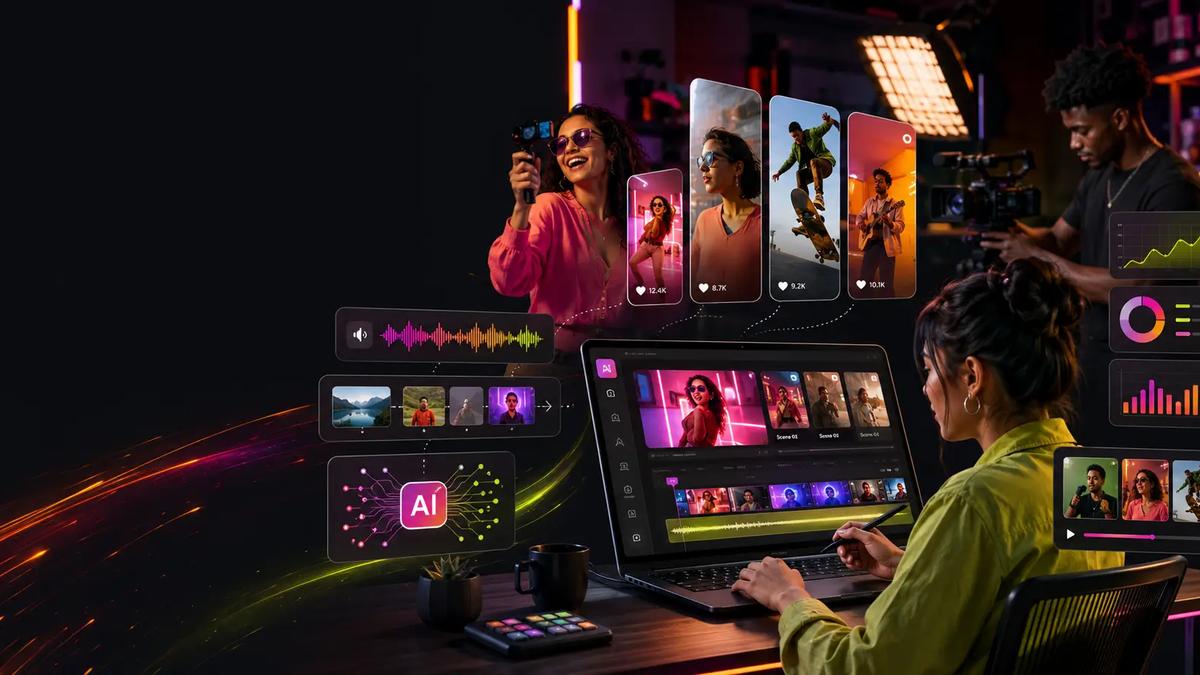
The creator economy is no longer limited by production skills.
In 2026, a solo creator can turn an idea into a script, voiceover, visual sequence, captioned Short, and publishable video without a camera crew. That change sits at the center of the most important creator economy trends: AI video tools are lowering the barrier to entry, increasing content velocity, and making formats such as faceless content practical for far more people.
But easier production does not guarantee attention or income. When everyone can publish more, originality, judgment, and audience trust become more valuable.
AI is making content cheaper to produce, not easier to make worth watching.
The creator economy is the ecosystem in which individuals build audiences and earn money from content, expertise, influence, or communities. It includes creators, platforms, advertisers, subscribers, agencies, creator economy companies, and the software used to produce, distribute, and monetize content.
That is also the clearest creator economy meaning or definition: people turn attention and trust into a business, often without a traditional media company between them and the audience.
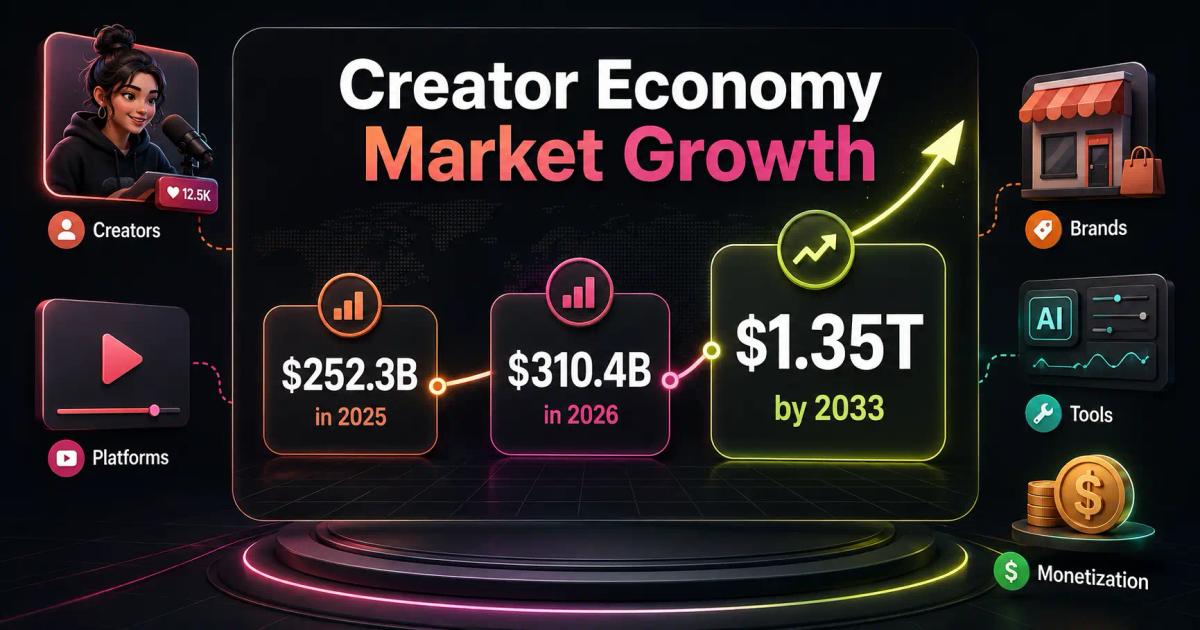
The scale explains why the category matters. Grand View Research's creator economy market report valued the global creator economy market at $252.3 billion in 2025, estimated it at $310.4 billion in 2026, and projected it could reach $1.35 trillion by 2033 at a 23.3% CAGR. Precedence Research's creator economy market analysis gives a similar 2026 estimate of $313.95 billion and projects the market could reach $2.08 trillion by 2035. In the US alone, IAB projected creator advertising spend would reach $37 billion in 2025, up 26% year over year. Nearly half of creator ad buyers described creators as a “must buy.”
So, how big is the creator economy, and how much is the creator economy worth? No single estimate captures every sponsorship, subscription, digital product, platform payment, course, affiliate sale, or UGC contract. But multiple market researchers now put the 2026 creator economy above $300 billion, with long-term forecasts above $1 trillion if current growth holds.
These creator economy statistics point to a structural market, not a social-media side note. Grand View also found that video streaming led creator economy platform revenue in 2025, while individual content creators were the largest end-use segment. That is directly relevant to Frameloop: the creator is becoming a small media company, and creator economy tools are becoming its production stack.
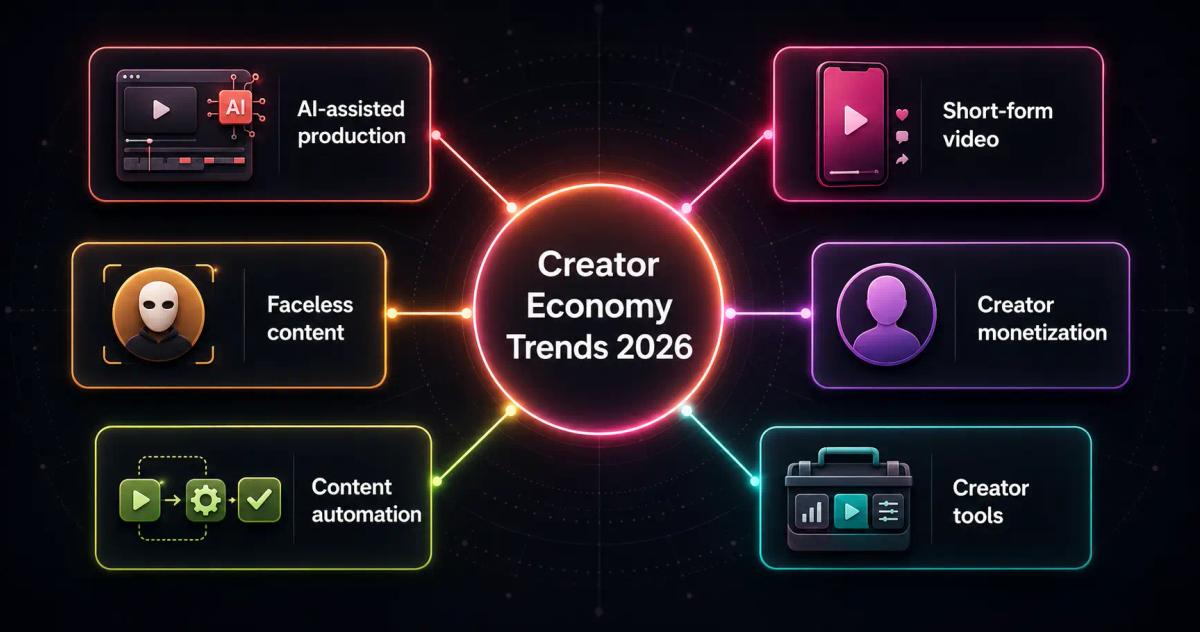
The leading creator economy trends in 2026 are AI-assisted production, video-first distribution, faceless formats, smaller creator teams, and more pressure to prove originality. Together, they are changing who can create, how often they publish, and what audiences consider valuable.
AI is no longer an occasional brainstorming assistant. Among the most useful AI content creation statistics, Adobe's 2026 Creators' Toolkit Report found that 75% of creators using creative AI consider it integrated or essential to their work, while 87% said it accelerated the growth of their business or audience.
Creators now use generative AI for niche selection, research, scripting, storyboards, text-to-video, AI avatars, AI voiceover, translation, captions, thumbnails, and video editing automation. The practical benefit is not merely speed. A creator can attempt formats that previously required several specialists.
Short-form video gives creators fast feedback on hooks, topics, characters, and formats. YouTube says Shorts now average more than 200 billion daily views, giving solo creators access to a distribution surface once reserved for large media budgets.
A creator can test ten concise concepts before committing to a long-form series. That makes Shorts, faceless Reels, and vertical video useful not only for reach, but also for product research.
MrBeast-scale production still demands people, capital, and operational discipline. AI does not turn one person into a large studio. It does, however, let a solo creator cover more of the workflow before hiring.
The winning model is increasingly a small creative team with strong taste and high-output tools. Batch content creation handles repeatable work, while humans decide the angle, verify claims, shape the story, and reject weak scenes.
AI video tools compress several production stages into one connected process. Instead of moving from a writing app to an image generator, voice tool, caption service, music library, and timeline editor, creators can generate a structured first version and refine it.
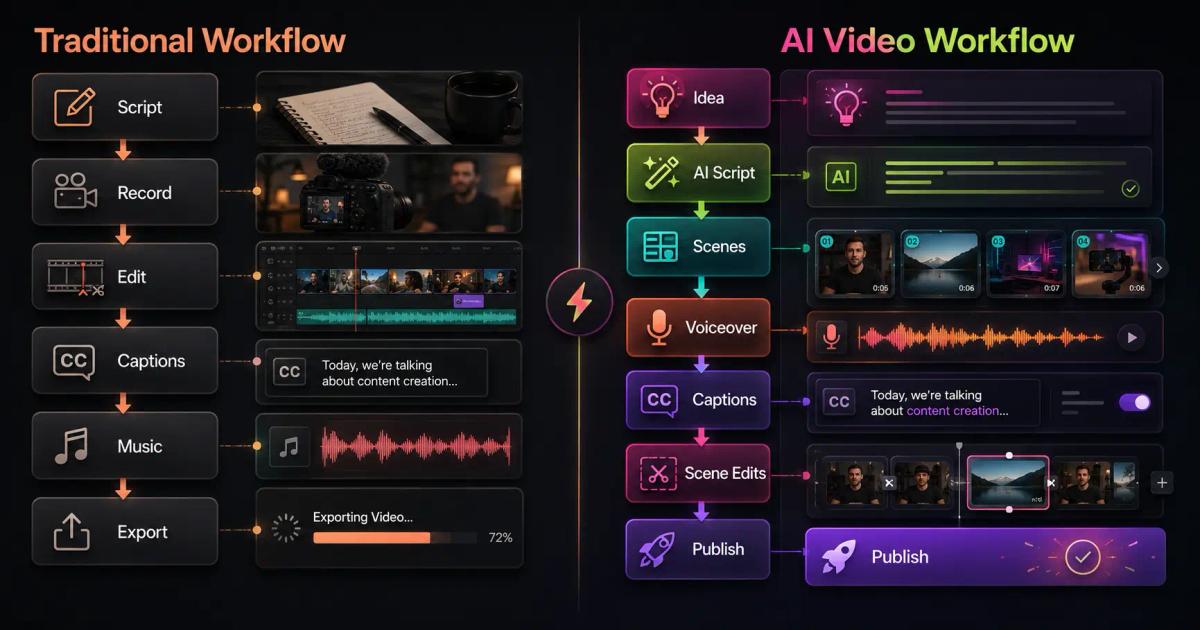
That distinction matters. A one-click output is rarely the finished work. Research from a 14-week study of AI-assisted video creation found that AI helped a newsroom publish videos that received more than 500,000 views, but human editorial critique remained essential because creators still needed to identify and correct flawed output.
Frameloop follows that human-in-the-loop model. Its AI video creation features combine script generation, scene breakdown, visuals, animation, natural voiceovers, captions, music, and 32+ language support. A scene-based editor then lets creators fix a weak image, voiceover, or section without discarding an otherwise useful video.
The best AI video workflow removes repetitive labor while preserving the decisions that make a creator recognizable.
For a practical setup, use AI for the first draft and mechanical production, then review four things manually:
Hook: Does the first scene create a clear reason to continue?
Story: Does every scene move the idea forward?
Accuracy: Are names, facts, visuals, and claims correct?
Identity: Does the result sound and look like your channel?
That final review is where content becomes yours.
AI content automation lets creators complete repeatable production tasks with fewer tools, less technical knowledge, and lower upfront cost. It is most useful for scene creation, resizing, captions, voiceovers, translations, formatting, and publishing support.
Traditional video production has several barriers: equipment, editing skill, on-camera confidence, time, and the cost of failed experiments. Content automation reduces those risks. A beginner can validate a niche with a small batch instead of paying for a full production setup before knowing whether the audience cares.
Content creation automation also makes multilingual and multi-format distribution more realistic. One researched idea can become a vertical Short, a faceless Reel, a narrated explainer, and a regional-language version. The creative idea stays central; the packaging changes for each channel.
The danger is confusing automation with strategy. More uploads do not repair a weak premise. YouTube clarified in 2025 that repetitive or mass-produced material falls under its inauthentic content monetization policy. AI-assisted content can be monetized, but low-value YouTube automation is not a dependable route to passive income channels.
Use AI content automation to increase the number of thoughtful experiments, not to flood a channel. That is the difference between useful scaling content and disposable volume.
A faceless YouTube channel publishes videos without making the creator's face the central visual. It can use narration, animation, screen recordings, stock footage, original illustrations, AI-generated scenes, or recurring characters.
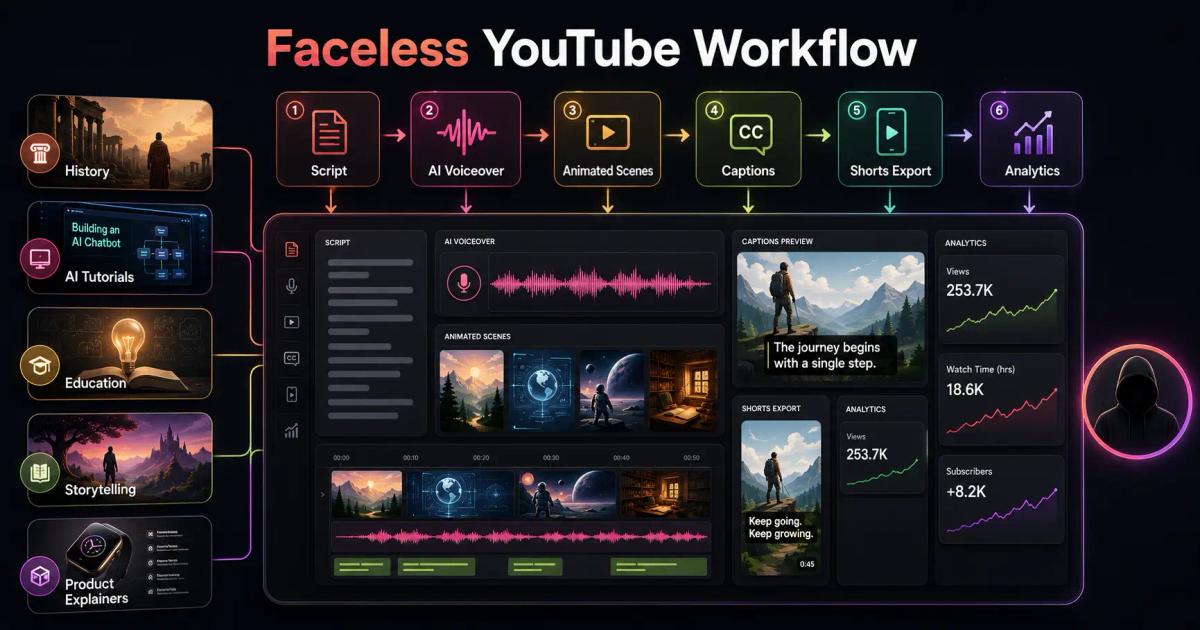
The format is growing because creators can build a recognizable media brand without a studio, presenter, or daily on-camera performance. A faceless video generator can turn a script into scenes, narration, captions, and music, leaving the creator to concentrate on the idea and edit.
If you are researching how to start a faceless YouTube channel, begin with the audience problem, not the software. Choose one narrow promise, write three repeatable episode formats, publish enough tests to learn, and review retention before scaling.
Useful faceless YouTube channel ideas include:
There is no universal list of the best faceless YouTube niches 2026 can guarantee. A good niche sits where audience demand, creator knowledge, visual potential, and monetization options overlap. Frameloop's guide to faceless video ideas that perform well can help narrow the options, but niche selection still requires testing.
Can you start a YouTube channel without showing your face or recording your voice? Yes. AI voiceover, licensed narration, screen capture, animation, and text-to-video workflows make both optional. What remains mandatory is meaningful creative input.
AI changes creator monetization by lowering the cost and time required to test content, serve niche audiences, and produce assets for multiple revenue streams. It does not change the basic rule that revenue follows valuable attention and trust.
Creator monetization can include advertising, sponsorships, affiliate income, memberships, subscriptions, digital products, services, licensing, and UGC. Lower production costs improve the economics of small niches because a creator needs fewer views or customers to cover each experiment.
But RPM is only one number. A narrowly focused tutorial channel may generate fewer views than entertainment content while creating more software referrals, consulting leads, or product sales. Smart creators track revenue per format and audience, not just revenue per thousand views.
Discovery matters after production. Frameloop's free AI YouTube hashtag generator can help organise relevant hashtags, but titles, thumbnails, viewer satisfaction, and topic demand carry more weight than a long tag list.
The durable model is not “post automatically and collect passive income.” It is to use creator economy tools to learn faster, build useful intellectual property, and diversify income beyond one platform payout.
Yes, AI video tools are good enough to help build a real channel in 2026, provided the creator supplies the positioning, facts, taste, and final quality control. They are strongest as a production system, not an autonomous channel operator.
Good tools can already handle scripting support, scene generation, voice cloning with permission, AI voiceover, captions, music, translation, formatting, and basic editing. Weak spots remain: factual errors, generic hooks, inconsistent visuals, awkward pacing, and outputs that resemble hundreds of competing channels.
Frameloop is a practical fit for creators who want speed without giving up control. Its scene-based workflow supports detailed revision, which matters when one weak visual or line would otherwise force a complete regeneration.
The real competitive advantage is therefore not access to AI. Access is becoming common. The advantage is a repeatable editorial system that turns AI output into recognizable work.
The future of content creation is more accessible, more multilingual, more video-first, and more dependent on human judgment. Generative AI will continue to reduce production friction, while platforms place greater value on original, authentic, audience-specific work.
Expect three changes:
Creators become creative directors. They spend less time on mechanical edits and more time choosing ideas, directing style, and reviewing output.
Formats multiply. One strong concept can support Shorts, long-form videos, faceless Reels, ads, tutorials, and localized versions.
Identity becomes the moat. When competent production is widely available, voice, expertise, recurring characters, community, and trust separate memorable creators from generic output.
AI will not erase the difference between average and excellent content. It will make that difference easier to see.
The defining creator economy trend of 2026 is not full automation. It is creative leverage: one person can now explore more ideas, produce more polished video, and reach more languages without building a studio first.
Frameloop helps creators move from idea to editable video while keeping a human in control of the scenes, voice, pacing, and final result. That balance matters because the next wave of creator businesses will not win by publishing the most. They will win by learning faster and making work people choose to remember.

Got great video ideas but need help bringing them to life? Frameloop AI makes it easy to create professional faceless videos with AI-generated visuals, voiceovers, and editing.
Try Frameloop AI For Free