

Avinash Vagh

The fastest-growing AI story short channels in 2026 are not the ones with the most sophisticated tools. They are the ones that picked a proven format, built a repeatable workflow, and tested their hooks scene by scene.
One channel called "toon stories" has a single AI story short with 700 million views. No face. No team. Just a loop-optimized character story that replays in the viewer's mind without them thinking about it.
Most creators trying to build AI story short channels make the same mistake: they treat every video as a one-off experiment instead of building a system. They generate a video, something is slightly off, and because their tool regenerates everything when they touch anything, they start over. That is not a workflow. That is a reset button.
This guide covers the five story formats that are actually producing millions of views, the hook formulas that stop the scroll in three seconds, and the step-by-step workflow that turns one story idea into ten tested variations, all without starting from scratch.
Key Takeaways
YouTube Shorts now reaches 1.5 billion monthly users and hit 200 billion daily views in June 2025, up from 70 billion in March 2024. That is a 186% growth in 18 months. The platform is not slowing down.
Within that growth, one content format has pulled ahead of everything else: AI-generated narrative story shorts. Channels in the betrayal, revenge, transformation, and character story niches are growing at 21x the average rate, with remarkably low competition because most creators still think these are novelty formats.
They are not. They are the algorithm's favorite content type right now.
Here is why. The algorithm rewards watch time and replays. A well-structured story short that resolves in 20 seconds and loops cleanly generates both. The viewer finishes the video and the beginning plays again before they can scroll. That loop signal tells the algorithm the content is worth distributing further.
But there is a problem developing in this space. In July 2025, YouTube tightened enforcement against what it called "mass-produced repetitive AI content." Channels generating hundreds of identical-looking shorts using single-click tools started losing distribution. Generic output, produced in bulk with no creative direction, is being flagged.
The channels growing fastest are the ones doing the opposite: producing fewer videos with more intentional creative choices at the scene level.

Not every story format performs equally. These five are the ones producing results in 2026.
This is the "toon stories" format. A relatable or visually striking character, a simple conflict introduced in the first five seconds, a satisfying resolution, and a final frame that flows naturally back to the opening.
The loop is not accidental. It is designed. The last line of the script calls back to the opening image or phrase, so when the video restarts, it feels intentional rather than abrupt.
Optimal length is 15 to 30 seconds. Shorter formats retain more viewers but give less time to establish the conflict. 30 seconds is the sweet spot for character stories with an emotional payoff.
Three-act structure compressed into 45 to 60 seconds. Normal life, a betrayal, an unexpected and satisfying comeback. The emotional arc is complete within the video, which drives both watch completion and shares.
This niche has 21x growth because it taps into universal emotions with no cultural barrier. A betrayal story works in Hindi, Portuguese, Arabic, and English without needing translation of the feeling, only of the words.
Faceless channels running this format with AI voiceover are the ones with channels like "aistory 2.0" at 222 million views and "crazy ai story" at 111 million views.
The script is written in first person: "POV: you just discovered something is living in your attic." The viewer becomes the character. The tension is immediate and personal.
This format works particularly well for horror-adjacent stories, unexpected discovery narratives, and wish-fulfillment scenarios. The hook is embedded in the format itself: a POV framing signals the viewer they are about to experience something, not just watch it.
A character or situation dramatically changes in 20 to 30 seconds. Fantasy upgrades, dramatic reversals, underdog victories. The resolution delivers a complete emotional payoff, and the contrast between the before and after states is large enough to be visually striking.
The loop potential here is high. Viewers rewatch to catch the exact moment of the change.
This is the format that English-only creators are entirely missing. Only 17% of internet users speak English as their primary language. Hindi, Portuguese, and Arabic channels are outperforming many English-language story channels simply by being the only AI story short creator targeting their language.
One story, five languages, five uploads. The same 30-second betrayal narrative in Hindi reaches 600 million+ potential viewers that the English version never touches.
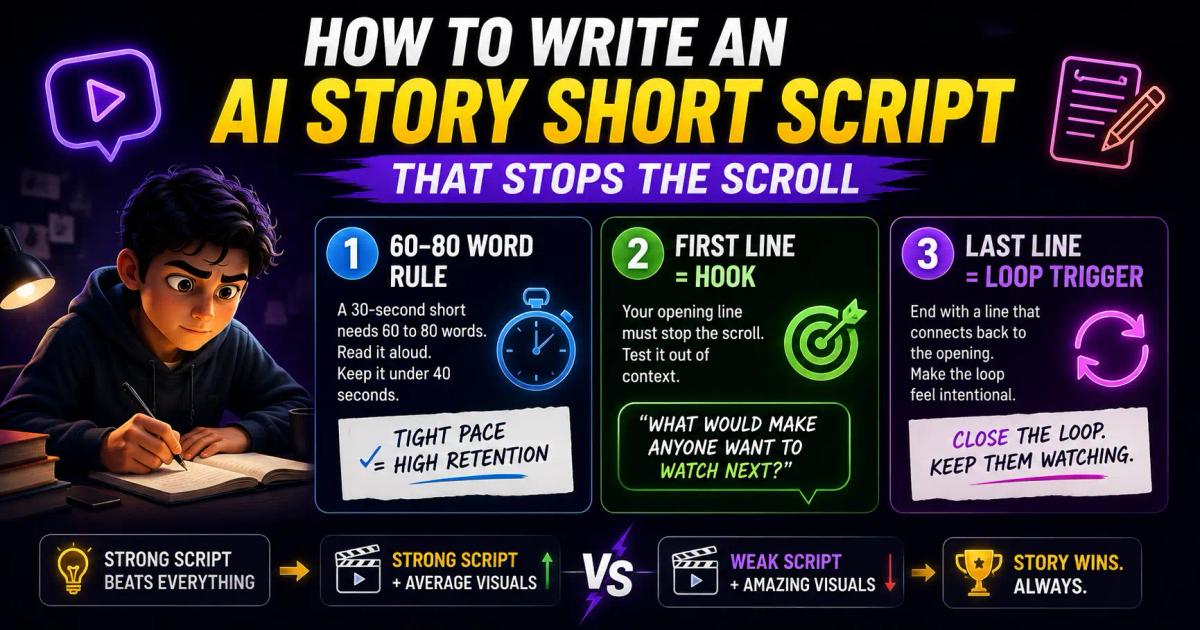
The script controls everything. A strong script with mediocre visuals outperforms a visually polished video with a weak hook every time.
The 60 to 80 word rule: A 30-second short needs 60 to 80 words of script. Read it aloud at a natural pace. If it runs over 40 seconds, it is too long. Cut until the pacing is tight.
First line = hook: The first sentence of your script must work as a standalone hook. If someone heard only your opening line, would they keep watching? Test this by reading it to someone out of context.
Last line = loop trigger: The final sentence should connect back to the opening image or idea. "And she finally understood what she had always known" lands differently when it loops back to the opening scene of her standing in the same place.
| Hook Type | Example | Why It Works |
|---|---|---|
| Bold statement | "This tiny character just destroyed a kingdom." | Creates an immediate curiosity gap |
| Surprising reveal | "Nobody believed her. Until this happened." | Pattern interrupt before the conflict |
| Urgent question | "What would you do if your best friend betrayed you?" | Emotional pull that makes the viewer self-insert |
| Countdown tension | "She had three seconds to decide." | Manufactured urgency the algorithm rewards |
| Incongruity | "The smallest thing in the room had the most power." | Cognitive dissonance that demands resolution |
One rule above everything else: if your analytics show fewer than 70% of viewers passing the three-second mark, change only the hook and repost. Do not rebuild the entire video. A/B test the opening line, keep scenes two through the end unchanged.
Marcus started building a faceless AI story short channel in January 2026 with no video production experience. He picked the betrayal niche, wrote his first script, and used a one-click AI video tool to generate a short. The result looked identical to 40 other channels running the same tool. Three weeks and 12 videos later, he had 300 subscribers and zero videos above 5,000 views.
He switched his approach. Instead of regenerating full videos when something was off, he started editing scene by scene: testing three different hooks for each story by changing only scene 1, keeping scenes 2 through 8 intact. Six weeks later, one variation hit 800,000 views. Same story, same resolution, different opening line in scene 1.
That is what scene-by-scene creative direction looks like in practice.
Here is the workflow:
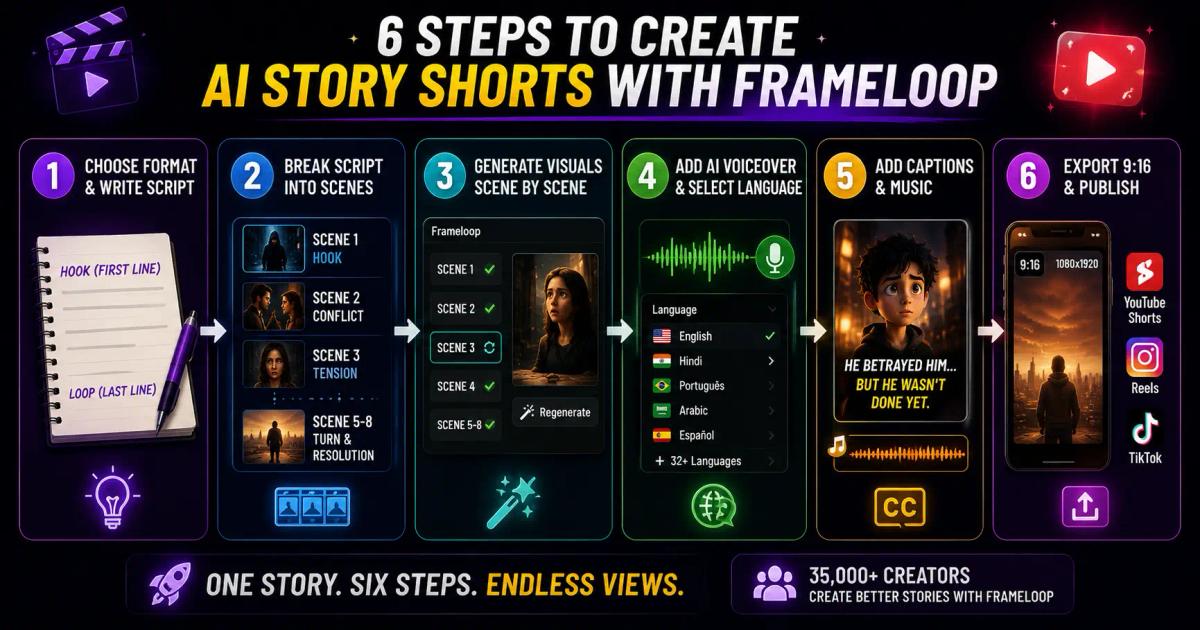
Step 1: Choose your format and write the script
Pick one of the five formats above. Write or generate a 60 to 80 word script. Read it aloud. Time it. First line is the hook. Last line is the loop trigger. Every line between serves the arc.
Step 2: Break the script into scenes
A 30-second story short typically has five to eight scenes. Each scene has a single job: establish character, introduce conflict, escalate tension, deliver the turn, resolve. Map each script line to a scene. Scene 1 always carries the hook.
Step 3: Generate visuals in Frameloop, scene by scene
Paste your script into Frameloop's AI story generator. The platform generates visuals for each scene independently. If scene 3 looks wrong, change scene 3. Scenes 1, 2, 4, and 5 stay exactly as they are. No re-render. No starting over.
This is how scene-based AI video editing changes the production math: testing 10 hook variations becomes a 15-minute task instead of a day's work. It is why 35,000+ creators have switched from "AI generates my video" to "AI and I direct my video."
Step 4: Add AI voiceover and select your language
Choose a voice that matches the emotional tone of your story format. Dramatic for betrayal and revenge. Whimsical for character loops. If you are targeting a multilingual audience, switch the voiceover language per export. One script becomes five uploads across five languages in minutes. The AI reel generator handles the format conversion for Instagram Reels automatically.
Step 5: Add captions and background music
80% of Shorts viewers watch on mute. If your story depends on audio to make sense, it will underperform. Captions are not optional. Bold, high-contrast text. Animated timing if possible.
Background music should sit at 20 to 30% volume. Enough to feel, not enough to compete with the voiceover.
Step 6: Export in 9:16 and publish
Minimum 1080x1920 resolution. Export and publish to YouTube Shorts, Instagram Reels, and TikTok simultaneously. For the first 30 days of a new channel, one to two AI story shorts per day is the algorithm ignition threshold.
Ready to try this workflow? Create your first AI story short at frameloop.ai with no credit card and no watermark on exports.

The difference between a creator and a content operator is a system.
Priya runs a betrayal-niche AI story short channel targeting Hindi-speaking viewers. Every Sunday afternoon, she produces 10 story shorts for the week. Not 10 separate video projects. Ten variations from three core story arcs.
Here is the math: three story arcs, two hook variations per story, export in Hindi and English. That is 12 videos from three scripts in about three hours.
The hook variation method: Write one story. Create three different opening scenes (scene 1 only) using different hook types from the formula table above. Keep scenes 2 through 8 identical. Export all three. You now have three videos for the work of generating one.
The language multiplication method: Take your best-performing English story short and generate the identical video in Hindi, Portuguese, and Arabic by switching the voiceover language and regenerating captions. Each language version reaches an entirely different audience. You are not creating four videos. You are distributing one story four times.
For creators serious about building a faceless story channel at scale, the faceless YouTube channel guide covers the full production system, from story ideation to publishing cadence.
The AI story short channels hitting millions of views in 2026 have two things in common: they picked a proven format and they tested their hooks without rebuilding entire videos.
Betrayal and revenge narratives are growing at 21x. Loop-optimized character stories have produced 700 million single-video view counts. Multilingual story shorts are reaching audiences of 1B+ that most English-only creators have never considered.
The workflow is straightforward: pick a format, write a tight 60 to 80 word script, generate visuals scene by scene, add AI voiceover and captions, export in 9:16. Where this breaks down for most creators is at the iteration stage: changing something means starting over. That is where scene-based editing changes the production math. Change scene 1. Keep everything else. Export three hook variations. Let the algorithm tell you which one to double down on.
Try the complete AI story short workflow at frameloop. Your first story short takes about 2 minutes. Your tenth takes about one.
Got great video ideas but need help bringing them to life? Frameloop AI makes it easy to create professional faceless videos with AI-generated visuals, voiceovers, and editing.
Try Frameloop AI For Free