

Avinash Vagh
YouTube automation has become one of the most searched creator business models online. It attracts students, founders, side hustlers, marketers, and creators because it offers leverage. Instead of filming yourself daily, editing every frame manually, and spending hours producing content, you can build systems that help a channel run efficiently.
That is the appeal.
But many beginners misunderstand the opportunity.
They think YouTube automation meaning is passive income with zero effort. It is not. Real channels still need strong ideas, compelling hooks, retention-focused storytelling, packaging, and consistency.
The difference in 2026 is that AI tools make production dramatically easier.
Video demand is growing at an extraordinary pace. According to Grand View Research’s video production market report, the global video production market was valued at USD 70.40 billion in 2022 and is projected to reach USD 746.88 billion by 2030, growing at a 33.5% CAGR.
With platforms like YouTube, TikTok, Instagram Reels, and Netflix driving constant demand for video content, creators now need faster and smarter ways to produce at scale. That is why YouTube automation is becoming a major opportunity for modern creators using AI.
Scripts can be generated faster. Voiceovers can sound natural. Visuals can be created on demand. Editing can be streamlined. Small creators can now produce content like teams used to.
This guide explains how to start YouTube automation, what niches work, how monetization happens, what mistakes to avoid, and how Frameloop AI helps creators build faceless channels faster.
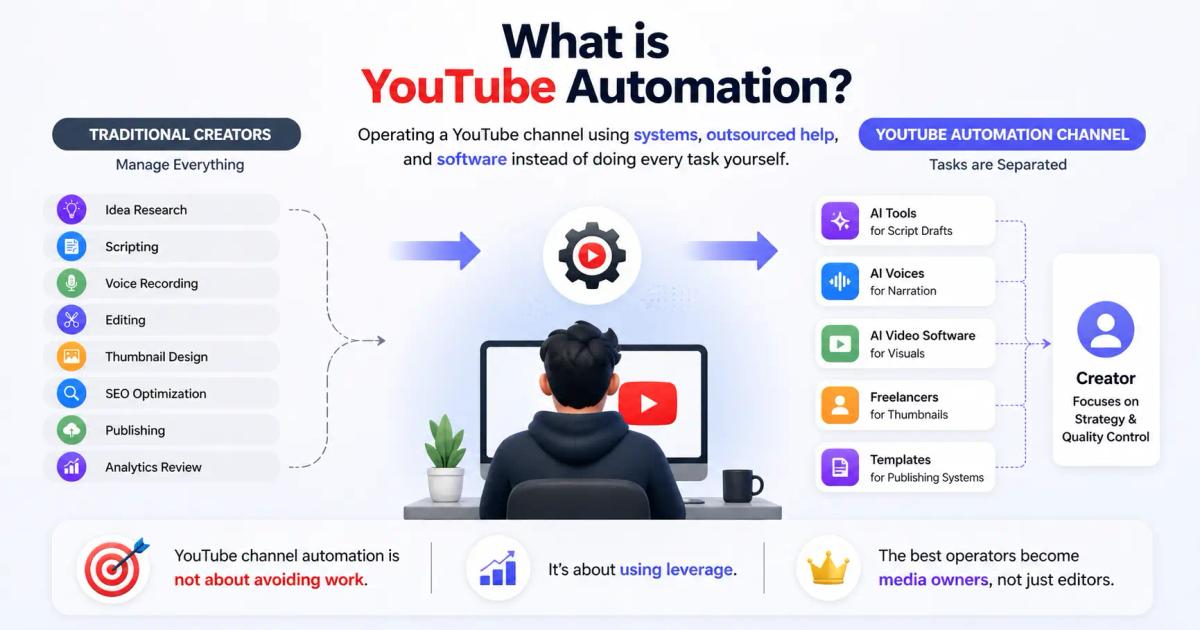
It means operating a YouTube channel using systems, outsourced help, and software instead of doing every task yourself.
Traditional creators often manage:
A YouTube automation channel separates those tasks.
That may look like:
So YouTube channel automation is not about avoiding work. It is about using leverage.
The best operators become media owners, not just editors.
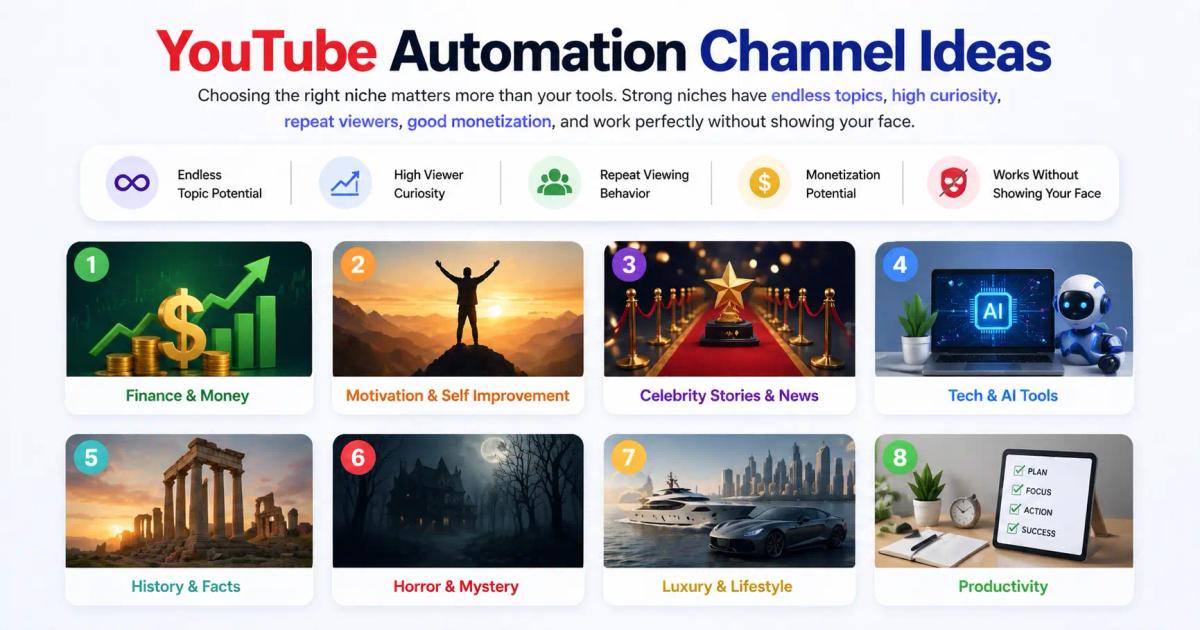
Choosing the right niche matters more than your tools.
A weak niche with low interest, poor monetization, or low repeatability will struggle even with the best AI workflow. A strong niche can grow with average production if the ideas are sharp.
The best YouTube automation channel ideas usually share these traits:
Below are high-performing niches with deeper breakdowns.
Finance remains one of the most valuable YouTube categories because advertisers pay premium rates and viewers actively search for solutions.
Strong subtopics include:
Why it works:
People care deeply about money stress and wealth building. Topics create emotional urgency.
Best style:
Narrated faceless explainers, charts, story-based videos.
Example titles:
This niche performs because human insecurity is timeless.
People constantly search for confidence, discipline, masculinity, emotional resilience, productivity, and mindset upgrades.
Strong subtopics:
Why it works:
Highly emotional, evergreen, strong watch-time if storytelling is good.
Best style:
Cinematic narration, dramatic visuals, powerful pacing.
Example titles:
People are endlessly curious about status, fame, scandal, wealth, relationships, and downfall stories.
This makes celebrity content highly clickable.
Strong angles:
Why it works:
Humans are wired to study high-status people.
Best style:
Storytelling with visuals, timelines, narrative suspense.
Example titles:
One of the fastest-growing niches in 2026.
Every week new tools launch. Users need tutorials, comparisons, and trusted recommendations.
Strong angles:
Why it works:
High search demand + affiliate revenue potential.
Best style:
Screen recordings, faceless explainers, case studies.
Example titles:
Great for evergreen growth because people love learning when packaged well.
Strong angles:
Why it works:
Curiosity-based content travels globally.
Best style:
Documentary narration, maps, archive visuals.
Example titles:
Emotion-heavy content often performs strongly.
Strong angles:
Why it works:
Fear and suspense hold retention.
Best style:
Dark cinematic pacing, tension-driven scripts.
Example titles:
People love aspiration.
Strong angles:
Why it works:
Viewers project themselves into higher-status lifestyles.
Best style:
Elegant visuals, premium narration.
Example titles:
Excellent niche for repeat audiences.
Strong angles:
Why it works:
Pain is recurring. People constantly want more time.
Best style:
Minimal clean visuals, practical storytelling.
Example titles:
Do not start broad.
Bad example:
Better example:
Bad example:
Better example:
Specific niches grow faster because YouTube understands the audience quicker.
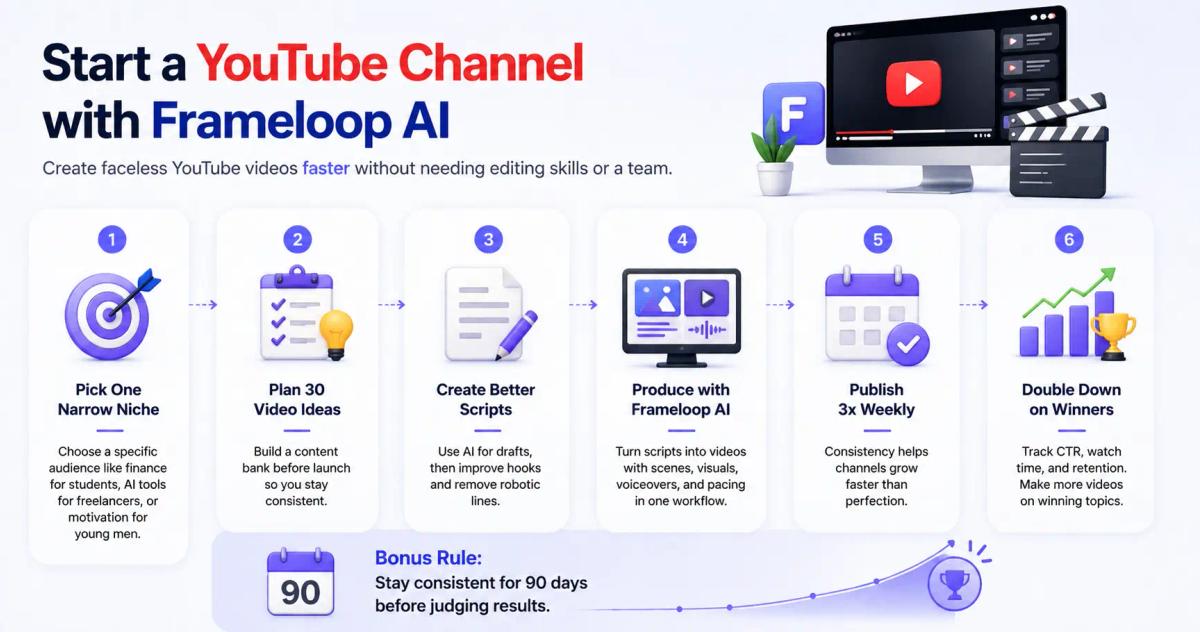
If you want to learn how to start YouTube automation, the smartest path today is to combine clear strategy with AI-powered production. Instead of spending weeks learning complex editing software or hiring a full team, you can use Frameloop AI to create faceless videos faster while keeping control over quality.
The goal is simple: launch quickly, publish consistently, and improve based on data.
Most beginners fail because they choose niches that are too broad.
For example:
These are massive categories with heavy competition.
A better move is choosing one specific audience and one emotional desire.
Examples:
Why this works:
Pick a niche where you can create at least 50 topics.
Never start with only two or three ideas.
That usually leads to burnout after week one.
Create a content bank of at least 30 titles before publishing your first video.
Use sources like:
Strong examples:
This gives you momentum and removes daily stress.
Use AI to create first-draft scripts quickly, but never publish raw AI output.
A strong workflow looks like this:
Use AI for structure and research
Rewrite the first 15 seconds manually
Add curiosity gaps
Tighten slow sections
Remove robotic phrasing
Focus especially on the opening hook.
Weak hook:
Today we will talk about confidence.
Better hook:
Most people lose confidence without realizing they repeat these 3 habits daily.
Hooks determine retention.
Now turn the script into a video using Frameloop AI.
Instead of juggling multiple tools, you can use one workflow to generate scenes, visuals, pacing, and narration.
Use Frameloop to:
This is especially useful for faceless YouTube because visuals carry attention.
For example:
Frameloop helps you move faster without sacrificing quality.
Most new creators obsess over making one perfect video.
That slows growth.
Early-stage channels need volume plus learning.
A better target:
Why this matters:
YouTube rewards consistency more than occasional perfection.
Once videos start getting traction, do more of what already works.
Look at:
If one topic performs well, make adjacent videos.
Example:
Winning video:
7 Side Hustles for Students
Next videos:
Do not guess. Follow evidence.
Give your channel 90 days of serious consistency before judging results.
Many creators quit after 8 uploads.
Real momentum often comes after:
Stay in the game long enough to improve.
Many creators slow themselves down by using too many disconnected tools.
A common beginner workflow looks like this:
This creates friction, extra cost, and lost momentum. Instead of focusing on publishing videos, creators spend time managing software.
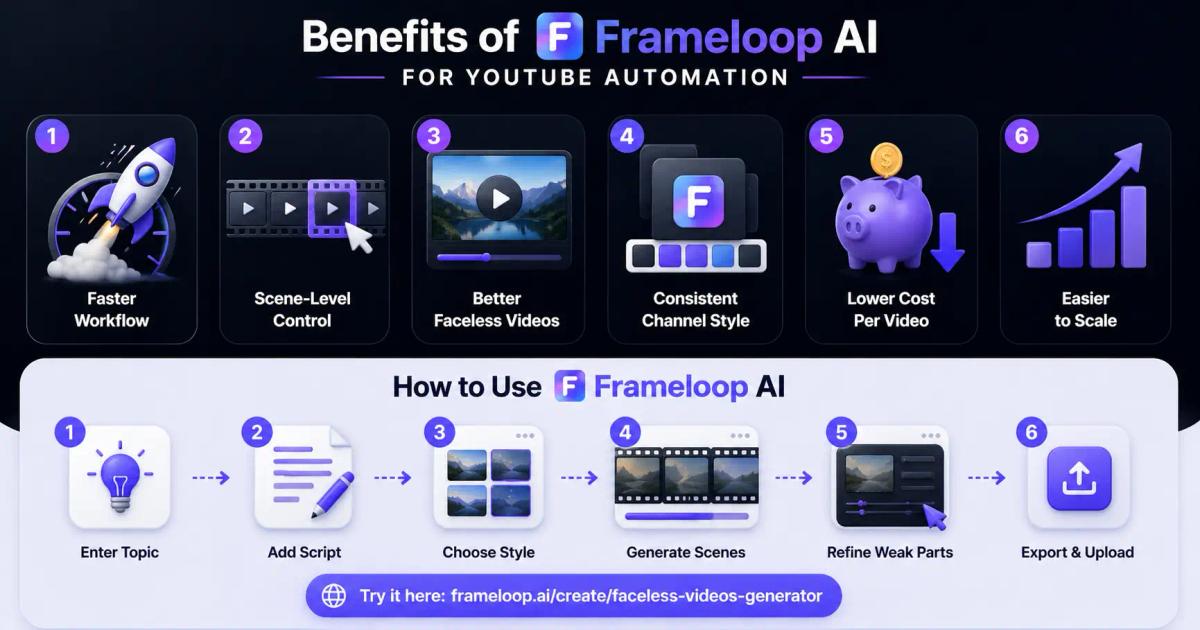
Frameloop simplifies that process by bringing key parts of faceless video creation into one workflow. For anyone building a YouTube automation channel, speed matters, but quality matters just as much.
Here is where Frameloop adds real value.
The biggest advantage of AI is speed, but many creators lose that advantage by switching between tools.
Frameloop helps move from idea to publish-ready content faster.
A practical workflow can look like:
Add your topic
Generate or paste script
Create scenes automatically
Add narration
Refine pacing
Export video
This can save hours compared to traditional editing workflows.
For creators uploading multiple videos each week, time saved compounds quickly.
Many AI video tools generate one full video at once. If one scene looks weak, the common solution is to regenerate everything.
That wastes:
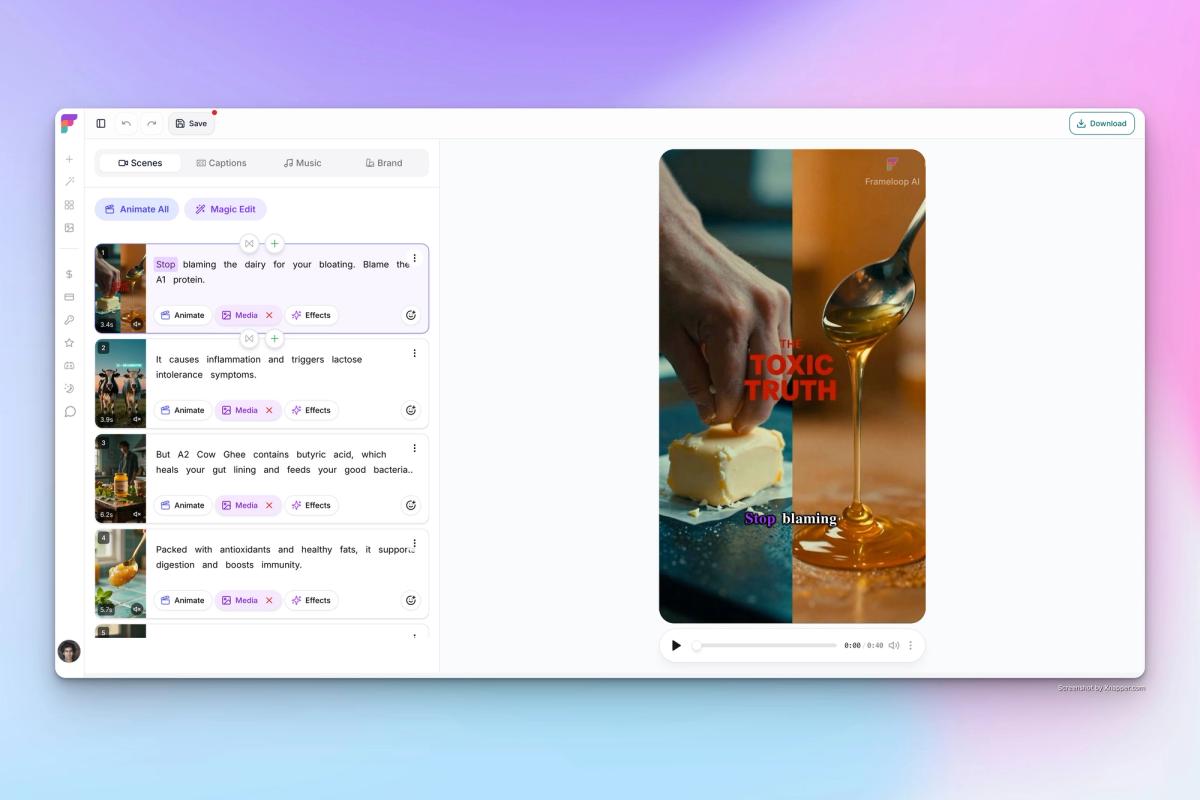
Frameloop uses a scene-based system, which means you can improve only the weak parts.
Examples:
This gives creators a much better balance of automation and control.
Faceless YouTube channels depend heavily on visuals because your face is not carrying attention.
That means viewers judge your content through:
Frameloop helps creators build stronger faceless content by making scenes more engaging instead of relying on generic slideshow output.
This is especially useful in niches like:
Better visuals often lead to better watch time.
Winning YouTube channels usually feel recognizable.
They may use recurring:
When every upload feels random, audience loyalty becomes harder.
Frameloop helps creators maintain a consistent style across multiple videos, which is important for building channel identity over time.
Consistency also helps viewers know what to expect, which increases return viewers.
Many creators only look at monthly software pricing.
The smarter metric is cost per usable video.
Example of a poor workflow:
That increases hidden costs.
With Frameloop, creators can fix mostly-good drafts instead of starting over. That lowers waste and improves production efficiency.
This matters even more for creators trying to scale to:
Once a channel gains traction, creators need systems.
Frameloop supports scale because it helps standardize production rather than relying on chaotic manual editing each time.
That means easier delegation, faster iteration, and smoother publishing.
Enter your topic
Add or generate script
Choose visual style
Generate scenes
Refine weak moments
Export and upload
Try it here: https://frameloop.ai/create/faceless-videos-generator
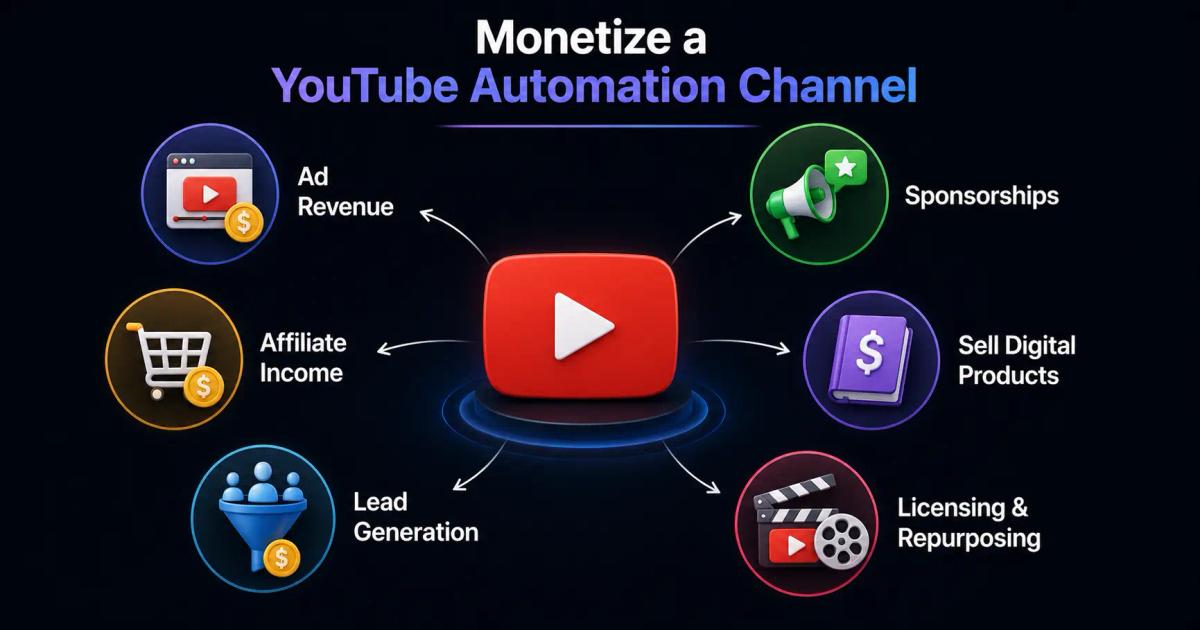
A serious YouTube automation channel should think beyond AdSense alone. Smart creators build multiple income streams so the business does not depend entirely on views. The strongest channels often combine ads, affiliate offers, sponsorships, and owned products.
The most common starting point is YouTube AdSense through the YouTube Partner Program (YPP). Once your channel meets YouTube’s eligibility requirements, you can earn from ads shown on your videos.
Income depends on factors such as:
Channels in finance, business, software, and education often earn higher RPMs than meme or entertainment channels.
Affiliate marketing is one of the best monetization models for automation channels because it can outperform AdSense with fewer views.
You recommend products and earn a commission when viewers buy through your link.
Examples:
A well-matched affiliate offer can turn a small but engaged audience into meaningful revenue.
Brands pay channels to access targeted audiences. Once your channel builds trust in a niche, sponsorships can become a major revenue source.
Examples:
Even smaller niche channels can land deals if the audience is specific and engaged.
Owned products create higher margins than ads.
You can sell:
For example, a productivity channel can sell planning templates, while a finance channel can sell beginner investing resources.
Some creators use YouTube to attract clients rather than earn directly from views.
Examples:
A channel with 10,000 targeted subscribers can be more valuable than a random channel with 500,000 viewers.
Strong content can also be repurposed across other platforms like TikTok, Instagram Reels, Facebook, or Shorts. This creates more reach from one asset and can open new monetization opportunities.
You can also license original clips or storytelling content to media pages and publishers in some niches.
Do not wait until you are “big.”
A smarter model is:
Start with AdSense
Add one relevant affiliate offer
Build an email list
Launch a simple digital product
Add sponsors once traffic grows
This creates a more stable business over time.
Yes, but not lazy creators.
Winning channels usually:
Many anonymous channels now earn real income.
The opportunity is real.
The shortcut fantasy is not.
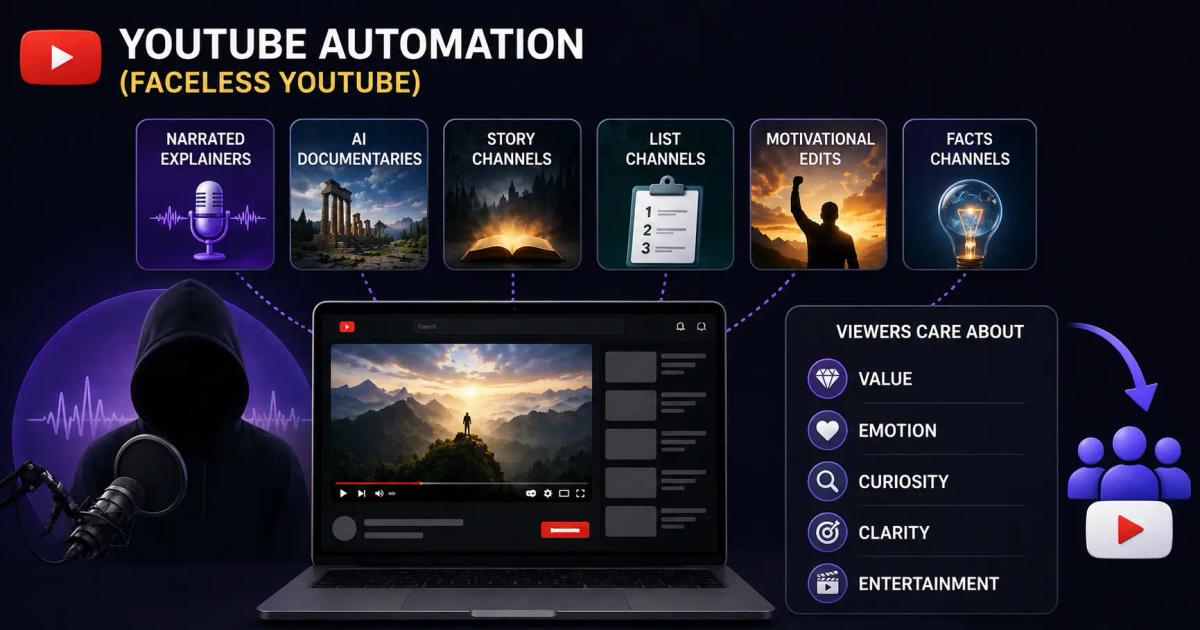
Most people mean faceless YouTube when they say automation.
That includes:
Viewers do not care if they see your face.
They care about:
That is why faceless channels can scale aggressively.
Watch demo: https://frameloop.ai/demo
YouTube automation is not dead. It is evolving.
Old automation meant low-quality bulk uploads.
Modern automation means using AI intelligently while keeping human judgment where it matters.
That means:
Creators who combine speed with quality will dominate the next wave.
If you want to build a faceless YouTube channel faster, try Frameloop AI.
Start here: https://frameloop.ai/signup

Got great video ideas but need help bringing them to life? Frameloop AI makes it easy to create professional faceless videos with AI-generated visuals, voiceovers, and editing.
Try Frameloop AI For Free