
Avinash Vagh
AI video tools are becoming the standard way to make content. Creators now use them to plan, edit, and publish videos faster with less manual work. The shift shows in the numbers. The AI media market stands at about USD 26 billion in 2024 and moves toward nearly USD 100 billion by 2030. AI video generators grow even faster, rising from around USD 0.4 billion to over USD 2.3 billion. Short-form video also expands, driven by mobile creators who rely on AI to speed up production and keep up with demand.
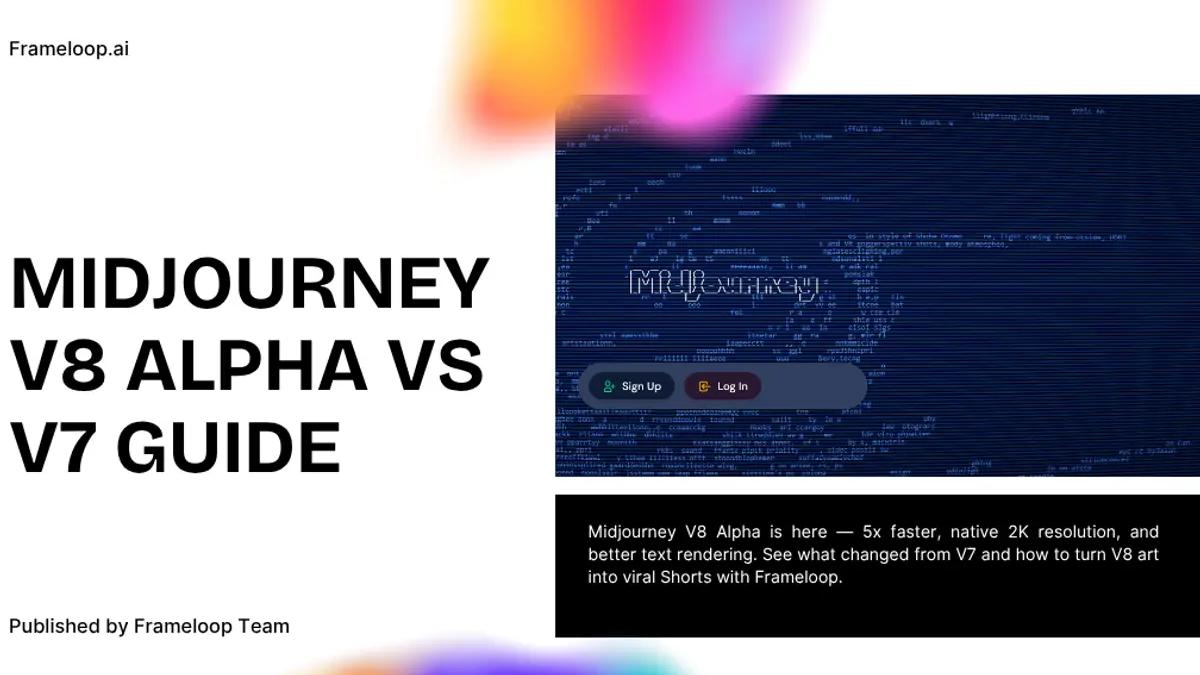
Midjourney V8 Alpha is the newest image generation model from Midjourney, released on March 17, 2026 as a preview model on the separate alpha website. It is not the default model yet—V7 still is but V8 is being tested in public with a goal of eventually replacing it.
The company describes Midjourney V8 as a fundamentally new model rather than a minor upgrade, with faster generation, stronger prompt understanding, better text rendering, and a new HD mode for native 2K images.
You will not find Midjourney V8 on the regular midjourney.com interface or in the Discord bot. To use V8 Alpha, you need to:
Relax mode is not available yet in Midjourney V8 Alpha, so all jobs run in a fast, paid mode.
Midjourney says V8 Alpha is its fastest model so far, with standard jobs rendering about 4–5 times faster than earlier versions. The alpha website UI has been redesigned to keep up with the speed, adding a grid view and sidebar settings so parameters do not block the images.
For creators running large batches of images for thumbnails, character packs, or storyboard frames, this speed bump is the most immediately noticeable change.
V8 Alpha introduces a new --hd parameter that generates images natively at 2K resolution without needing an upscaler. There is also a --q 4 quality mode that pushes coherence and detail further at a higher GPU cost.
Some important details:
For professional work where 2K images matter—posters, print, detailed frames for video—--hd is the key feature, but you will feel the GPU burn.
The official docs and early testers agree on one thing: V8 handles detailed instructions better than V7 and produces more coherent images. Text rendering inside images sees a noticeable improvement when you wrap the text you want in quotation marks in the prompt.
In early tests, prompts like a cat carrying a signboard reading “Midjourney V8 Alpha” produced legible text more often than in V7, though not with 100% reliability. External reviewers still note that diffusion‑only V8 trails behind hybrid autoregressive models such as Google’s Nano Banana or OpenAI’s GPT‑Image when prompts get very complex.
In plain language: V8 is better than V7 at following normal prompts and writing text, but it still struggles with highly specific, multi‑constraint scenes.
V7 made personalization the heart of Midjourney, and V8 doubles down on that.
Key points:
For creators building a consistent aesthetic brand visuals, recurring characters, or a recognizable “Midjourney look” for a channel, these tools matter more than raw image quality.
Here is a simplified comparison of Midjourney V7 and V8 Alpha based on the official feature chart and early reviews.
| Feature | V7 (current default) | V8 Alpha (preview) |
|---|---|---|
| Default availability | Main site + Discord | Alpha site only |
| Speed | Fast | ~4–5× faster |
| HD images | Upscale only | Native 2K with `--hd` (4× GPU) |
| Text inside images | Improved vs V6, still spotty | Noticeably better, still not perfect |
| Prompt adherence | Strong but sometimes “vibey” | Better with detailed prompts, still weaker than some hybrid models |
| Personalization | Draft Mode, Omni Reference, profiles | Same tools, stronger effect, heavy stylize recommended |
| Relax mode | Available | Not available yet |
| GPU cost | Normal | 4× for `--hd`, `--q 4`, style refs, moodboards |
| Max aspect ratio | 14:1 | 14:1 (4:1 for HD) |
The bottom line: V8 Alpha is faster, sharper, and more obedient than V7, but its best features are significantly more expensive and Relax mode is missing for now.
Despite the upgrades, V8 is still a pure diffusion model, which means it can lag behind hybrid autoregressive systems on tricky prompts requiring strict logical relationships. In early benchmark tests with complex instructions (for example, “a horse riding an astronaut, not the other way around”), V8 performed worse than models like GPT‑Image or Nano Banana.
Practical implications for creators:
For still images, this is manageable. For video workflows where you need dozens of frames, you have to plan your pipeline carefully.
V8 Alpha does not generate video by itself. It is still about images, just faster and sharper images with better style control.
Most creators who use Midjourney for content are trying to do things like:
That means a typical midjourney video workflow looks something like:
Design the aesthetic in Midjourney V7 or V8 Alpha with personalization, style references, or Niji 7 for anime.
Generate a batch of images at regular or HD quality.
Export them, then manually assemble them in a timeline editor or generic AI video tool.
Add script, subtitles, and transitions.
Regenerate and tweak if something feels off.
The friction shows up at steps 3–5. You are dragging still images into an editor that has no idea about your Midjourney style, and every change risks breaking the aesthetic or forcing you to rebuild the whole video.
Midjourney has occasionally demoed video‑like features, but the production model you use today is entirely focused on still images. There is no official “Midjourney shorts generator,” no built‑in script‑to‑video engine, and no way to string scenes together with voiceover and captions inside the platform.
That gap is exactly where a dedicated Midjourney to video workflow makes sense:
Frameloop sits on the video side of that workflow.
It is a faceless AI video generator designed to create short‑form content like YouTube Shorts, TikTok videos, Reels using scene‑level editing and visual styles that feel at home next to Midjourney V7 and V8 images.
For creators working with Midjourney:
Think of it as a Midjourney‑aware shorts generator: you keep the strengths of Midjourney V8 (personalized styles, HD frames, better text) and add timing, pacing, and voice.
Use Midjourney V8 with personalization and moodboards to define a unique aesthetic—say, neon noir cityscapes.
Generate 6–10 images that represent different scenes in that style.
Import them into Frameloop and choose a matching visual style so transitions and filler shots stay on‑brand.
Paste a short script; Frameloop turns it into a multi‑scene short with motion, voiceover, and captions.
If one scene does not work, fix it with scene‑level editing instead of re‑generating the whole short.
This replaces a complex manual edit with a predictable Midjourney video workflow.
Use V7 or V8 Alpha (or Niji 7 for anime) to generate a recurring character in multiple poses.
Upload those images into Frameloop as character scenes.
Use script to video AI to tell that character’s story in a short format like explainer, joke, product pitch, or mini‑tutorial.
Publish to YouTube Shorts or TikTok as a faceless channel where the character is the “face.”
Frameloop handles pacing, scene order, and audio while your Midjourney character keeps the visual identity consistent.
Use Midjourney V8’s better text rendering to generate frames that include labeled charts, headlines, or signs is wrapping the text in quotes for more reliable output.geekycuriosity.
For each news story, create 3–5 frames: hook, body, and closing frame.
Drop them into Frameloop’s AI news video workflow using text‑to‑speech and auto‑subtitles.
Generate vertical news shorts that feel like Midjourney‑powered motion graphics rather than static slides.
This combines V8’s improved text inside images with Frameloop’s ability to generate clear narration and captions.
If any of these describe you, the V8 + Frameloop pairing is a good fit:
Frameloop gives you a place to send your Midjourney V8 creations when you are done generating stills and ready to tell a story.
If you are already experimenting with Midjourney V8 Alpha and want to see your images move, try this:
Generate a small set of V8 images in your favorite aesthetic.
Bring them into Frameloop.
Use one of the built‑in styles that matches your Midjourney look.
Turn them into a short in under 10 minutes.
That is all it takes to go from “Midjourney V8 gallery” to “Midjourney aesthetic video” with scene‑level control if anything feels off.
Frameloop is free to try, with no watermark on exports, so you can test this Midjourney V8 to video workflow on a real short before committing.
Got great video ideas but need help bringing them to life? Frameloop AI makes it easy to create professional faceless videos with AI-generated visuals, voiceovers, and editing.
Try Frameloop AI For Free